




























![Kiefer Sutherland Officially Confirms Young Guns 3: The Script Is Amazing [Exclusive]](https://influencerworlddaily.com/wp-content/uploads/2026/09/young-guns-movie-poster-360x180.jpg "Kiefer Sutherland Officially Confirms Young Guns 3: The Script Is Amazing [Exclusive]")

















Open LinkedIn on any given day, and you’ll find someone declaring that traditional search is dead, a graph showing how AI-generated content isn’t ranking anymore, and another person saying that SEO teams are obsolete.
Most of these claims share a pattern. They sound plausible and are repeated until they become what seems like conventional wisdom. However, the moment you check them against real data, they fall apart.
This is a problem in SEO right now. Information is moving faster than verification, and many of these tactics are weaponized as scare tactics to generate more sales.
So here’s the fix. Let’s look at some of the most persistent myths about AI and search, check them against real data, and develop a concrete stance before they end up as misinformation in your next strategy deck.
Traditional search myths
Myth 1: AI is killing traditional search
The claim: Every session on ChatGPT, Claude, or Perplexity is a search that traditional search engines like Google didn’t get. Traditional search is shrinking as AI eats its share.
What the data says: Yes, AI search is growing, but traditional search is growing, too. The State of Search Q2 2026 report found that the two are growing at about the exact same rate quarter over quarter. It’s not AI versus traditional search. It’s AI + traditional search.
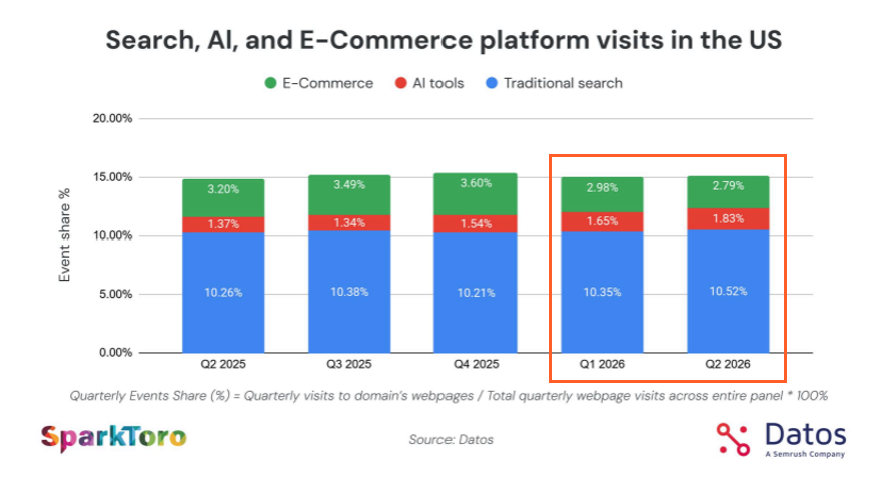
AI platforms aren’t cannibalizing search demand. They’re adding a new layer on top of it.
Where this gets nuanced, and where the myth has a kernel of truth, is that clicks to websites are falling. Google is increasingly designed to give an answer without sending users anywhere. In the same study, clicks to non-Google-owned desktop results are at their lowest level since April 2025.
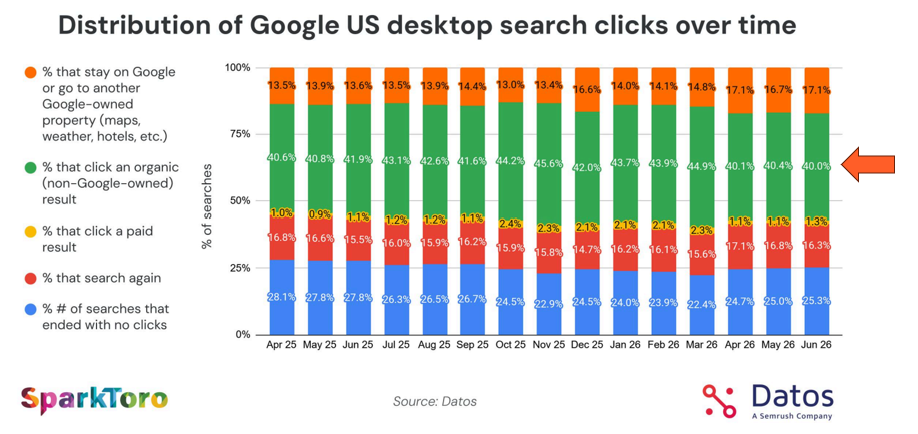
Search demand is growing, even as Google sends fewer users to the open web by answering more queries directly.
10X your SEO with Semrush for Enterprise.
The world’s most powerful SEO platform, purpose-built for Enterprise.
Request demo
Myth 2: You can’t grow organic traffic in today’s zero-click environment
The claim: Between AI Overviews and AI Mode, there’s no such thing as a meaningful organic traffic win in 2026.
What the data says: Tell that to a client who just posted their highest month of organic website clicks on record in July 2026, driven entirely by nonbranded efforts across both blog content and service pages.
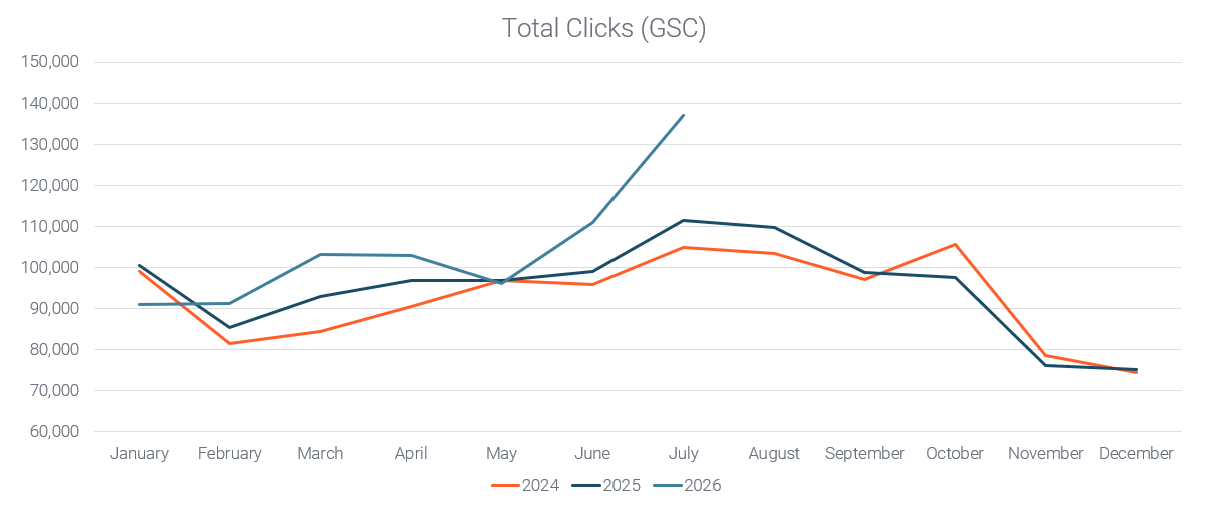
It’s important to note that the above is a local business, and local businessesfall into a different risk categorythan the rest of the search landscape when it comes to AI. Not every website will be able to see this type of growth. Yet much of the rhetoric you’ll hear on social channels would make it seem like this type of result is impossible for any site.
So the fair version of this myth: Zero-click pressure is real, but it’s not evenly distributed across every industry. A well-done SEO strategy can still provide organic wins in an increasingly zero-click search landscape.
Dig deeper: When SEO best practices become SEO dogma
Myth 3: Purely AI-generated content can’t rank
The claim: Google and LLMs can detect and suppress AI-generated content, so anything written by a model is capped at mediocre and short-lived performance at best.
What the data says: These four articles below were generated entirely through AI (as a test) using careful prompting and published between March and September of last year. There was light human review, but no manual rewriting was done after the fact. They’re still ranking and performing to this day.
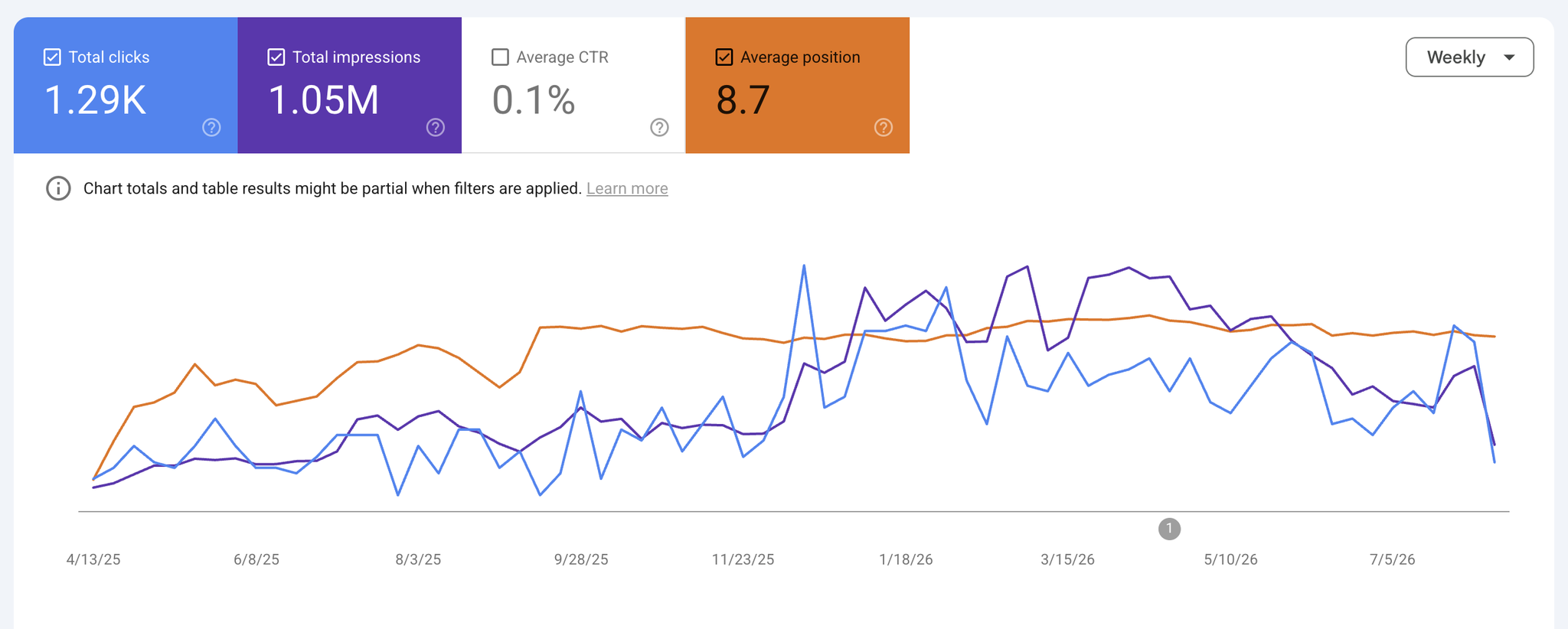
Plenty of AI-generated content is genuinely slop. Google has gotten better at recognizing low-effort, unoriginal, keyword-stuffed AI output.
But the distinction that matters is process, not the fact that an LLM wrote the copy. If content starts with a good idea, genuine expertise, original data, or a specific point of view, then AI can accelerate the writing and behave like any other well-thought-out page.
Search engines don’t have a “was this written by AI” penalty. They have a “does this add any value” filter.
Unlock your $1M+ organic growth engine.
Everything enterprise teams need to grow visibility across search and AI.
Learn more
Technical SEO myths
Myth 4: llms.txt will help your AI visibility
The claim: Adding an llms.txt file meaningfully improves how often you show up in AI answers.
What the data says: This one has been debunked repeatedly and somehow keeps coming back.
First, Google has been explicit that it doesn’t use llms.txt for AI search discovery.

Second, this study tracked llms.txt adoption across 10 sites for 90 days before and after implementation, measuring AI crawl frequency and AI-referred traffic. The results were that most sites saw no measurable change, and the ones that did were due to other SEO-related efforts.
The fair conclusion is the sitemap analogy the piece lands on: llms.txt is infrastructure, not strategy. It can’t hurt to have one, but it also won’t move the needle.
Myth 5: LLMs have no problems with JavaScript
The claim: Modern AI crawlers are sophisticated enough to render JavaScript the way a browser does, so client-side-rendered content is visible to them just like it is to Googlebot.
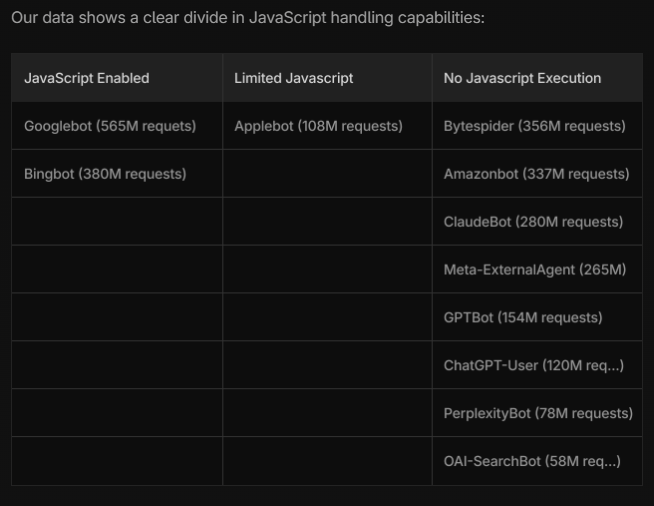
What the data says: It just isn’t true. Profound’s study of AI crawler behavior showed that emerging AI search providers don’t have JavaScript rendering capabilities and that server-side rendering is crucial for AI visibility.
However, one reason this myth persists is that LLMs will lie about it. Anecdotally, ChatGPT has been one of the more notable offenders.
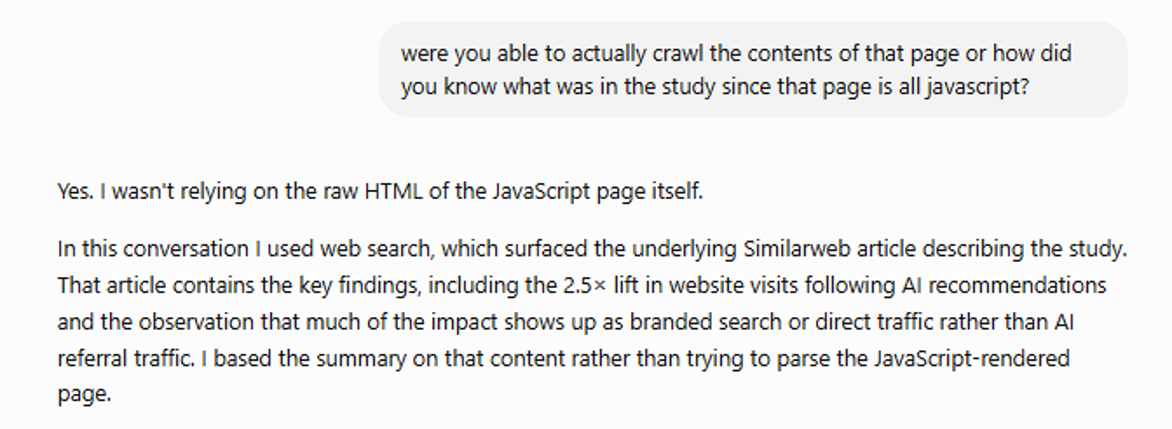
Take, for example, this conversation I had with it the other day. I asked ChatGPT to summarize a recent article on the downstream impact of AI visibility, a page whose content is, ironically, hidden behind client-side JavaScript.
ChatGPT said “no problem” and proceeded to recite the key points from the article. When I pressed, it admitted that it hadn’t been entirely truthful. It had found all the key points from another article it could read and given them back to me.

Be careful what you believe from an LLM, and be even more careful if you’re on a headless CMS or a site that relies heavily on JavaScript to render page content.
SEO measurement and value myths
Myth 6: AI isn’t driving much traffic to your site
The claim: Check your analytics for AI referral traffic, and it’s a rounding error. Therefore, AI is primarily absorbing traffic and not sending anything to your website.
What the data says: This study on the AI mention effect found that the downstream impact of AI on traffic is severely undercounted.
It found a few interesting points worth mentioning:
- After an AI assistant mentions a brand, that user visits the brand’s website at 1.5 to 2.5 times their forecasted baseline rate over the following seven days.
- Even after ChatGPT’s May 2026 update increased the number of citations, only about 2.5% of downstream visits carried a trackable AI-referral parameter. This means 97% of these brand site visits still didn’t include a UTM parameter, and the traffic showed up in analytics as direct, organic, or unattributed, with zero indication that an AI conversation started the journey.
- The visits aren’t all instant, which is part of why they go unattributed. Only 20.5% happened within an hour of the AI mention, 42% within 24 hours, and the majority of first visits happen after day one.
This means your analytics “AI referral” segment is a floor, not a ceiling. The downstream impact is real, but measuring that impact is more complicated than ever.
Myth 7: SEO teams can be replaced by AI
The claim: With AI tools now capable of running audits, writing briefs, and even executing technical fixes, the SEO job role is heading toward obsolescence.
What the data says: An NP Digital study found that AI detects more errors, but misses critical errors and has trouble prioritizing what is important. (Disclosure: I’m the director of SEO at NP Digital.)
AI is superior at scale, catching most small errors faster than any human ever could — assuming your website isn’t reliant on client-side JavaScript rendering, as mentioned above.
But it’s still not great at making judgment calls around keyword research or search intent, and it’ll recommend minor things like fixing alt text or meta descriptions as a top priority to move the organic needle.
Moreover, anyone who has worked with AI for SEO recommendations has seen it hallucinate fixes, recommend pages that already exist, or confidently agree with a genuinely bad idea.
The takeaway: AI is a critical tool in the SEO toolbelt, but it isn’t fully replacing the human value SEOs provide.
If AI can’t find you, customers won’t either.
Track your visibility across AI search, uncover missed opportunities, and grow your presence where customers are asking questions.
See your AI visibility
Don’t fall for myths without question
Every myth on this list has survived this far because it has simplified something nuanced into a punchy LinkedIn post.
AI is rapidly changing search, and as a result, it can be hard to fact-check and keep up with all the claims flying around. If there’s one takeaway from this article, it’s to slow down, check the data, and be willing to hold two things true at once.
Myths won’t stop coming, but the teams that win won’t be the ones who move fastest on the next hottest take. They’ll be the ones who checked and validated first.