











































Our July article ended with a simple rule: remove what you can and suppress what you can’t. This article covers the second half of that rule using our own campaign data.
We reviewed 714 suppression campaigns launched between August 2024 and May 2026. For each, we tracked where the negatives started, how many positive assets we published, how long it took to clear page one, and which negatives wouldn’t move.
Removal still comes first when possible. In our 2026 removal data, court records, mugshots, and people-search listings usually came down within about two weeks. News articles and government pages were harder to remove. Those two categories also make up most of the negatives in our suppression work.
We also looked at what suppression means for AI answers. The short version: page two may no longer be far enough.
Where negative results start
The typical campaign started with three negative results on Page 1. Across all 714 campaigns, we tracked 2,461 negatives.
Most ranked high. In 43% of campaigns, a negative held the No. 1 spot for the person’s or company’s name before we started. In 75%, at least one negative ranked in the top three. About three in 10 campaigns started with five or more negatives on Page 1.
News articles and government pages accounted for about three in four of the negatives we tracked.
Starting position predicts the outcome
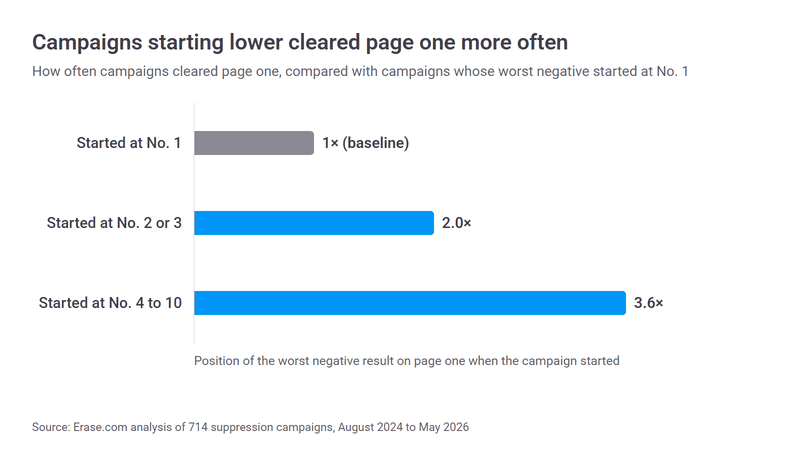
The best predictor of a clean Page 1 was where the worst negative started.
Campaigns whose worst negative started at No. 4 or lower cleared page one about 3.5 times as often as those starting at No. 1. Campaigns starting at No. 2 or No. 3 cleared about twice as often.
The number of negatives mattered almost as much. Campaigns with one negative cleared Page 1 about four times as often as those with six to 10.
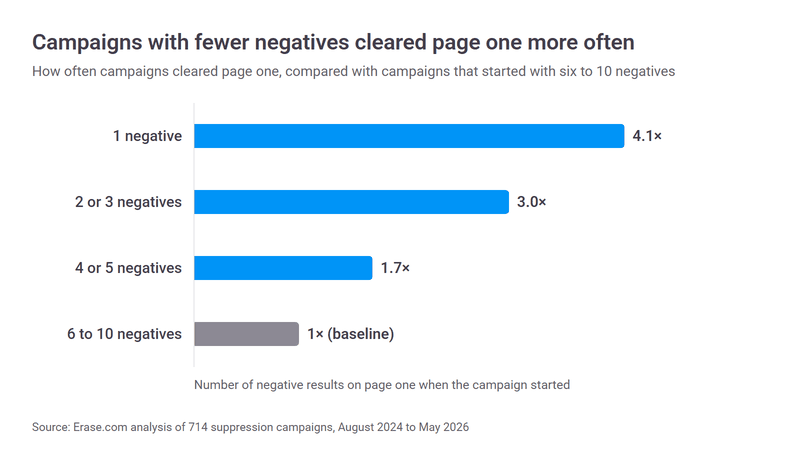
Use both numbers when scoping a campaign. One negative at No. 7 and five led by a No. 1 result are different jobs, even though both are called “suppression.”
Volume isn’t what separates the wins
The typical campaign published 29 positive assets, or about 10 a month.
Campaigns that cleared Page 1 didn’t publish more. They published a median of 28 assets, compared with 29 for campaigns that didn’t clear. The difference was placement. Campaigns that cleared had a median of six new assets in the top 10, compared with four for those that didn’t.
Track how many assets reach the top 10 each month, not just how many you publish.
We also sampled the assets that reached Page 1. Contributed articles and interviews made up about 35%. Press releases and the news pages that syndicate them made up 28%. Owned websites made up 19%, and business and bio profiles made up 13%.
By the time we built a second website for a client, the first almost always ranked in the top five. Second sites were slower. About a third had reached Page 1 when we reviewed them, and most ranked on Pages 2 to 4.
How long suppression takes
Of the campaigns that cleared Page 1, 40% did so by the end of month two, 63% by month three, and 85% by month four. We measured time as months active at review, so actual timelines may be slightly shorter.
Across all our historical data, 59% of content can be suppressed within three months and 99% within six months.

A separate set of 46 documented cases shows the same pattern. The median was four months, and most negatives landed on page two. A few took much longer. The slowest took 16 months.
Plan for three to four months as the working range. That fits the two- to six-month estimate in our July article. The more negatives you have and the higher they start, the closer to the long end you should plan.
What’s easy and what’s hard to push down
We labeled 2,239 negatives as either pushed off Page 1 or still on it. Here’s how the types compared:
| How hard to push down | Types of negative results |
| Easier | Court and legal record pages, mugshot, and arrest sites |
| In the middle | Local news, social media posts, government and regulator pages, major national outlets |
| Hardest | Reddit threads, review, and complaint profiles |
Court record pages left Page 1 more than twice as often as Reddit threads. National outlets were slightly harder to move than local ones.
Age mattered, too. We reviewed 25 Justice Department press releases. Those at least nine years old left Page 1 nearly five times as often as those five years old or newer.
Page 2 may not be far enough for AI answers
Suppression campaigns usually aim for Page 2. AI answers change that math.
In March, Ahrefs studied 4 million AI Overview citations across 863,000 keyword searches. Only 37.9% of the cited URLs ranked in the top 10 for that search. Another 31.2% ranked in positions 11 through 100. Ahrefs linked the change to “fan-out,” where Google runs related searches behind the scenes and pulls sources from those results.
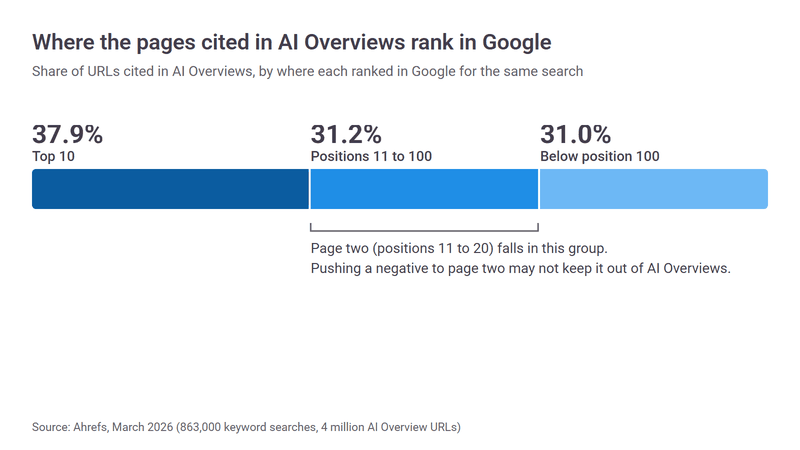
That matters for suppression. Most negatives in our documented cases landed on Page 2. That changes what people see in the blue links, but it may not keep the page out of AI Overviews.
Here’s how we’d adjust:
- Remove at the source whenever you can. A deleted page can’t appear in a new search or AI answer.
- Push the hardest negatives past Page 2, not just off Page 1.
- Treat positive assets as AI source material. Clear bios, owned websites, and contributed articles give AI tools better pages to cite.
- Check AI answers for the name each month and track which URLs they cite. Those URLs are your next targets.
How to scope a suppression campaign
Before you promise a timeline, gather four facts:
- How many negatives are on Page 1.
- Where the worst one ranks.
- What type each one is, such as news, government, Reddit, or court records.
- Which ones can be removed instead of suppressed.
Then set the plan. Remove what you can first. Plan three to four months for the rest. Report top-10 placements each month and add AI citations to the report.
If you want help, Erase.com runs suppression campaigns alongside removal, so each negative gets the path that fits it.
About the data
This analysis covers 714 Erase.com suppression campaigns launched between August 2024 and May 2026 that had sufficient data for review.
- A negative counts as suppressed when it no longer appeared on Page 1 at review.
- Time is measured in months active at the time of review.
- Asset types are based on a sample of Page 1 assets we published, not a full count.
- Removal figures are based on links submitted to Erase.com for removal between January and September 2026.