











Rob Zombie has a real gift for grime, noise, menace, and the feeling that every room smells bad in a way your soul can detect before your nose does. He can build atmosphere. He can find faces that look haunted before they speak. He can make America feel diseased. That is why his failures are so frustrating. There is always some version of a great horror filmmaker flickering inside the mess. Then the movies keep collapsing under the same problems: endless screaming, sadism with no modulation, characters flattened into filth and noise, and a weird inability to understand that ugliness is only powerful when it reveals something deeper than contempt for everyone on screen.
That is what makes these five so bad. They are not disasters because they are too nasty or too extreme. Horror can survive nastiness. Horror can survive bad taste. These films fail because they confuse abrasion with depth and mistake punishment for insight. Instead of getting under the skin, they often just sit on the nerves and grind.
5
‘Halloween’ (2007)
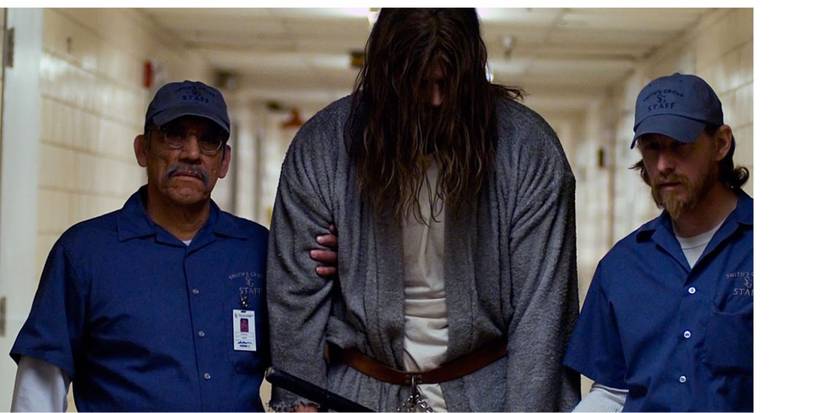
Michael Myers, played by Tyler Mane, escorted to trial in HalloweenImage via Dimension Films
The first problem with Halloween is that it fundamentally does not understand what made Michael Myers (Tyler Mane) frightening in the first place. John Carpenter’s original works because Michael feels blank in the most terrifying sense, like violence stripped of biography, motive, self-pity, and psychological neatness. Zombie charges in the opposite direction and starts stuffing the first half with backstory, abuse, cruelty, screaming parents, bullying, redneck rot, dead animals, all of it hammering away at the same point until Michael becomes less a shape gliding through suburbia and more a very loud dossier.
That does not make him more interesting. It makes him smaller. Worse, it drags the entire film into Zombie’s usual trap of treating every human interaction like a race to the bottom in vulgarity and misery. The world is so aggressively ugly so early that the movie has nowhere to escalate emotionally once adult Michael breaks loose. Laurie Strode (Scout Taylor-Compton) does what she can, and there are scattered images that work, but the whole thing mistakes explanation for intensity. Michael stops feeling mythic and starts feeling over-authored. That is death for this material. The terror is no longer in what cannot be understood. It is buried under a pile of “look how damaged this is,” which is a much less frightening idea.
4
‘The Lords of Salem’ (2012)
Sheri Moon Zombie in The Lords of Salem.Image via Anchor Bay Films
The Lords of Salem is the Rob Zombie movie people most often try to rescue on atmosphere alone, and I understand the temptation. It looks good in a sickly, dreamy way. It has patience. It has mood. It has that drifting, narcotic style that makes you think maybe this time he is finally going to shape all his ugliness into something truly haunting. For a while, the movie almost gets there. Heidi Hawthorne (Sheri Moon Zombie) is a far more interesting protagonist than a lot of Zombie’s leads, partly because Sheri Moon Zombie is not being asked to play loud psycho-trash this time but something more worn, lonely, chemically fragile, and spiritually exposed.
Then the film just keeps dissolving into empty occult posing. The witches, the broadcasts, the hallucinations, the Salem legacy, the giant symbolic imagery, the pregnant pauses, it all starts to feel less like dread accumulating and more like an art-horror screensaver made by someone who thinks repetition automatically becomes meaning if you dim the lights enough. The movie wants to feel like a descent. It mostly feels like a series of grotesque tableaus in search of an actual emotional engine. There is no tightening grip. No deepening psychological logic. No devastating unveiling. Just vibes, rotting womb imagery, and self-important nightmare décor. Atmosphere can carry a film very far. It cannot carry one all the way when the center never really comes alive.
3
‘Halloween II’ (2009)
Image via Dimension Films
This is where Zombie’s worst instincts really go feral. If the first Halloween made the mistake of overexplaining Michael Myers, Halloween II adds the equally fatal mistake of drowning everything in hysterical psychic sludge. Laurie Strode (Scout Taylor-Compton)’s trauma should have been the movie’s anchor. There was a real opportunity there to make a brutal, emotionally coherent sequel about survival, damage, identity fracture, and the way violence keeps living inside a person after the killer is gone. Instead the film turns trauma into a nonstop shriek, then smothers it in white-horse visions, spectral-mother nonsense, and dream logic so clumsy it feels like parody of “deep” horror rather than actual psychological descent.
The movie is exhausting in the deadest way. Not harrowing. Not overwhelming. Just exhausting. Every performance is pushed toward maximum abrasion. Every scene feels like it has been stripped of tonal intelligence. Danielle Harris and Scout Taylor-Compton are both left stranded inside a film that thinks suffering gets more profound the louder and filthier it becomes. Meanwhile Michael lumbers through the wreckage like a giant homeless berserker rather than an expression of nightmare. The original Halloween II from 1981 understood hospital-space dread with icy simplicity. This one replaces dread with chaos and calls the result intensity. It is one of the clearest examples of a filmmaker mistaking rawness for control.
2
‘3 from Hell’ (2019)
Richard Brake, Sheri Moon Zombie, and Bill Moseley in 3 From Hell.Image via Lionsgate
3 from Hell is depressing in a very particular way because it does not even have the nasty propulsion of Zombie’s earlier work. House of 1000 Corpses had chaotic energy. The Devil’s Rejects at least had conviction in its own depravity, even if you hated the film’s fascination with its monsters. 3 From Hell feels like a dead franchise shambling back up because nobody told it the pulse was gone. The Firefly clan were already stretched to the limit as antihero objects of cult fascination. Bringing them back after the ending of Rejects turns what should have stayed final into a grubby encore nobody needed.
And the movie has so little to offer beyond that cynical resurrection. Otis Driftwood (Bill Moseley) is still sneering filth, Baby Firefly (Sheri Moon Zombie) is still shrieking filth, the world around them is still packed with disposable victims and carnival-sideshow ugliness, but the rot is no longer charged. It is repetitive. Richard Brake brings some presence as Foxy Coltrane, enough to briefly make you wonder whether the movie might find a new rhythm with him, though Zombie has no real story worth building there. Once the action shifts to Mexico, the film becomes even more shapeless. There is no tragic inevitability, no fresh perversity, no meaningful escalation. Just tired sadists doing old tricks in a movie too self-amused to notice it is running entirely on fumes.
1
’31’ (2016)
Sheri Moon Zombie in 31.Image via Saban Films
31 is the bottom of the barrel because it strips Rob Zombie down to his most obnoxious impulses and leaves them there, naked, proud, and completely unsupported by craft or purpose. The premise sounds like mean little exploitation fun on paper: a group of carnies gets abducted and forced to survive a deadly game against costumed maniacs for twelve hours. Fine. There is a movie in that. A tight, vicious, class-drenched, midnight-madness survival horror movie could absolutely have been made from that setup. What Zombie delivers instead is a screeching endurance test built out of ugly digital grime, paper-thin characters, and one-note killer clowns performing nastiness like they are auditioning for a Hot Topic apocalypse pageant.
Doom-Head (Richard Brake) is the clearest example of the film’s disease. Brake is a terrific actor and arrives with enough bug-eyed intensity to make an opening monologue feel briefly electric, but the character is all surface voltage. He represents the whole movie: loud, dirty, theatrical, empty. None of the victims have enough shape for the violence to matter. None of the set pieces evolve beyond blunt-force harassment. None of the ugliness reveals anything except Zombie’s ongoing belief that if he fills the frame with enough screaming degenerates and carnival scum, horror will happen automatically. It does not. Horror needs rhythm, escalation, imagination, and some twisted understanding of human fear. 31 has almost none of that. It is merely abrasive, and abrasive is cheap.
Collider Exclusive · Horror Survival Quiz Which Horror Villain Do You Have the Best Chance of Surviving? Jason Voorhees · Michael Myers · Freddy Krueger · Pennywise · Chucky
Five killers. Five completely different ways to die — if you’re not smart enough, fast enough, or self-aware enough to avoid it. Only one of them is the villain your particular set of instincts gives you a fighting chance against. Eight questions will figure out which one.
🏕️Jason
🔪Michael
💤Freddy
🎈Pennywise
🪆Chucky
01
Something feels wrong. You can’t explain it — you just know. What do you do? First instincts are the difference between the survivor and the first act casualty.
02
Where are you most likely to find yourself when things go wrong? Setting is everything in horror. Where you are determines which rules apply.
03
What is your most reliable survival asset? Every survivor has a quality the villain didn’t account for. What’s yours?
04
What kind of fear is hardest for you to fight through? Knowing your weakness is the first step to not dying because of it.
05
You’re with a group when things start going wrong. What’s your role? Horror movies are brutally clear about who survives group situations and who doesn’t.
06
What’s the horror movie mistake you’re most likely to make? Honest self-assessment is a survival skill. Denial is not.
07
What’s your best weapon against something that can’t be stopped by conventional means? Every horror villain has a weakness. The survivors are always the ones who find it.
08
It’s the final scene. You’re the last one standing. How did you make it? The final survivor always has a reason. What’s yours?
Your Survival Odds Have Been Calculated Your Best Chance Is Against…
Your instincts, your strengths, and your particular way of thinking under pressure point to one villain you actually have a fighting chance against. Everyone else — good luck.
Camp Crystal Lake · Friday the 13th
Jason Voorhees
Jason is relentless, but he is also predictable — and that is the gap you would exploit.
He moves in straight lines toward his target. He doesn’t strategise, doesn’t adapt, doesn’t outsmart. He simply pursues.
Your ability to keep moving, use the environment, and resist the panic that freezes most victims gives you a genuine edge.
The Crystal Lake survivors were always the ones who stopped running in circles and started thinking about terrain, water, and distance.
You think like that. Which means Jason, for all his indestructibility, would face someone who simply refused to be where he expected.
Haddonfield, Illinois · Halloween
Michael Myers
Michael watches before he moves. He is patient, methodical, and almost impossible to detect — until it’s too late for anyone who isn’t paying close enough attention.
But you are paying attention. You notice the shape in the window, the car parked slightly wrong, the silence where there should be sound.
Michael’s power lies in the invisibility of ordinary suburbia — the fact that nothing ever looks wrong until it already is.
Your spatial awareness and instinct to map every room, every exit, and every shadow before you need them is precisely the quality Laurie Strode had.
You are not a victim waiting to happen. You are someone who already suspects something is wrong — and acts on it.
Elm Street · A Nightmare on Elm Street
Freddy Krueger
Freddy wins by getting inside your head — using your own fears, your own memories, your own subconscious as weapons against you. That strategy requires a target who can be destabilised.
You are harder to destabilise than most. You’ve faced uncomfortable truths about yourself and you haven’t looked away.
The survivors on Elm Street were always the ones who understood what was happening and chose to face it rather than flee from it.
Freddy’s greatest weakness is that his power evaporates in the presence of someone who refuses to give him the fear he feeds on.
Your psychological resilience — the ability to stay grounded when reality itself becomes unreliable — is exactly the quality that keeps you alive here.
Derry, Maine · It
Pennywise
Pennywise is ancient, shapeshifting, and feeds on terror — but it has one critical vulnerability: it cannot function against someone who genuinely stops being afraid of it.
The Losers Club didn’t survive because they were braver than everyone else. They survived because they faced their fears together, and faced them honestly.
You ask the questions others avoid. You look directly at what frightens you rather than turning away.
That directness — the refusal to let fear fester in the dark — is Pennywise’s worst nightmare.
It chose the wrong target when it chose you. You are exactly the kind of person whose fear tastes like nothing at all.
Chicago · Child’s Play
Chucky
Chucky’s greatest advantage is that nobody takes him seriously until it’s already too late. He exploits the gap between how something looks and what it actually is.
You don’t have that gap. You take threats seriously regardless of how they present — and you never make the mistake of underestimating something because of its size or appearance.
Chucky relies on surprise, on the delay between recognition and response. You close that delay faster than almost anyone.
Your instinct to treat every unfamiliar thing with appropriate scepticism — rather than dismissing it because it seems absurd — is the exact quality that keeps you breathing.
Against Chucky, not laughing is already winning. You are very good at not laughing.
We use cookies on our website to give you the most relevant experience by remembering your preferences and repeat visits. By clicking “Accept All”, you consent to the use of ALL the cookies. However, you may visit "Cookie Settings" to provide a controlled consent.
This website uses cookies to improve your experience while you navigate through the website. Out of these, the cookies that are categorized as necessary are stored on your browser as they are essential for the working of basic functionalities of the website. We also use third-party cookies that help us analyze and understand how you use this website. These cookies will be stored in your browser only with your consent. You also have the option to opt-out of these cookies. But opting out of some of these cookies may affect your browsing experience.
Necessary cookies are absolutely essential for the website to function properly. These cookies ensure basic functionalities and security features of the website, anonymously.
Cookie
Duration
Description
cookielawinfo-checkbox-analytics
11 months
This cookie is set by GDPR Cookie Consent plugin. The cookie is used to store the user consent for the cookies in the category "Analytics".
cookielawinfo-checkbox-functional
11 months
The cookie is set by GDPR cookie consent to record the user consent for the cookies in the category "Functional".
cookielawinfo-checkbox-necessary
11 months
This cookie is set by GDPR Cookie Consent plugin. The cookies is used to store the user consent for the cookies in the category "Necessary".
cookielawinfo-checkbox-others
11 months
This cookie is set by GDPR Cookie Consent plugin. The cookie is used to store the user consent for the cookies in the category "Other.
cookielawinfo-checkbox-performance
11 months
This cookie is set by GDPR Cookie Consent plugin. The cookie is used to store the user consent for the cookies in the category "Performance".
viewed_cookie_policy
11 months
The cookie is set by the GDPR Cookie Consent plugin and is used to store whether or not user has consented to the use of cookies. It does not store any personal data.
Functional cookies help to perform certain functionalities like sharing the content of the website on social media platforms, collect feedbacks, and other third-party features.
Performance cookies are used to understand and analyze the key performance indexes of the website which helps in delivering a better user experience for the visitors.
Analytical cookies are used to understand how visitors interact with the website. These cookies help provide information on metrics the number of visitors, bounce rate, traffic source, etc.
Advertisement cookies are used to provide visitors with relevant ads and marketing campaigns. These cookies track visitors across websites and collect information to provide customized ads.