







































[ad_1]
Akira Kurosawa is perhaps the most famous Japanese director of all time, and his filmography is an inarguably remarkable one. His first feature film came out in 1943, and his final feature was released exactly 50 years later, in 1993, with the director ultimately passing away in 1998, at the age of 88. Many of his films hold up beautifully, and even his earliest works still have a good deal to offer, even if much of his 1940s output saw him working out his strengths and capabilities as a director. After a string of movies that included great titles like Stray Dog (1949), Rashomon (1950), and Ikiru (1952), 1954 saw him release what many would say is his greatest film: Seven Samurai. And that’s a fair statement to make. It’s a classic in every way, telling a grand story over nearly 3.5 hours, and helping to redefine what action movies could be capable of. Yet even if it’s his most airtight and hard-to-fault movie, it still doesn’t represent everything he was capable of as a filmmaker. After all, Seven Samurai came just 11 years after Kurosawa’s first directorial feature. He had another four decades of his career to go, and his skills ended up growing even more in that time. It was 1985 that saw Akira Kurosawa release his grandest and arguably most impressive film: Ran
Ran, which is a Japanese word that roughly translates to “chaos” or “rebellion,” takes inspiration from Japanese history and the Shakespeare play King Lear, presenting a compelling narrative about an aging warlord trying to divide up his kingdom to his sons, and the disagreements about his decisions that lead to conflict, betrayal, and bloodshed. It’s a staggering achievement, and a film that gets better every time you revisit it, and seemingly only grows more powerful as time marches on. Kurosawa built upon various strengths of his previous films to give Ran everything he had as an artist, and it shows. He had to have the kind of career he did to be in a position to make something as ambitious and beautiful as Ran, and though it felt like a grand, final statement to cinema, it thankfully wasn’t his last film, and he ended up directing a handful of interesting movies during the last decade of his life. Overall, his career was an impressive and influential one, and Ran stands as arguably his most important film for a variety of reasons.
Akira Kurosawa Spent 40 Years Building Up to ‘Ran’

To understand how Ran serves as a culmination of Akira Kurosawa’s entire body of work, it’s vital to understand how his career progressed in the years leading up to 1985. Kurosawa’s time in the Japanese film industry commenced earlier than 1943, with him having some work as an assistant director and screenwriter as early as 1936, when Kurosawa himself was in his mid-twenties. Once he got his start, his 1940s movies tended to be solid for their time, if a little unremarkable by today’s standards. However, the aforementioned Stray Dog (1949) – a tense and well-acted take on the film noir genre – showed a ton of promise, and led to Kurosawa having an amazing hot streak of credits between 1949 and 1965. Beyond Seven Samurai, he also made other great samurai films like Yojimbo and Sanjuro, adapted Macbeth into the remarkable Throne of Blood, and also showed himself capable of directing contemporary films with epic scopes, as he did with the underrated The Bad Sleep Well (1960) and the comparable – yet even better – High and Low (1963), which both stand as compelling crime-dramas to this day.
1965 unfortunately saw him have a falling out with Toshiro Mifune, a legendary actor who’d collaborated with Kurosawa on 16 films. His first film after the falling out, Dodes’ka-den (1970), was regrettably a box office failure, despite being a genuinely good movie, and it hurt Kurosawa’s finances and saw him fall into a deep – and almost fatal – depression. Dodes’ka-den is viewed more favorably nowadays and is seen as vital for being the first time Kurosawa shot a film in color. After a five-year break, he made the well-received (and unexpected) Soviet co-production Dersu Uzala (1975), which seemed to restore some of his confidence in himself. Another five years later, he made the even more well-received Kagemusha (1980), his third film shot in color. These three films gradually show an increase in scope, runtime, and ambition, as well as continually bolder uses of color. While they’re all relevant to Ran because of these reasons, Kagemusha has even more relevance, given it’s also a historical drama about war and conflict, features scenes with numerous extras, and has several actors that also appeared in Ran, including the great Tatsuya Nakadai, who played the lead role in each.
‘Ran’ Is Kurosawa’s Most Epic & Ambitious Movie

So clearly, Akira Kurosawa was no stranger to epic films that dealt with large-scale, violent conflicts set many years in the past. He’d mastered the art of making a compelling historical drama decades before Ran was even in pre-production, as far back as the early-1950s, with Rashomon and Seven Samurai. Ran runs for a lengthy 162 minutes, and runtimes well over two hours were nothing new for Kurosawa either. Besides Seven Samurai and its 207-minute runtime, his last collaboration with Toshiro Mifune – 1965’s Red Beard – also exceeded three hours, and the longest cut of Kagemusha was exactly three hours long (an international cut still stands at an impressive 162 minutes). His multiple samurai films had ensured he was well-equipped to stage impressive action sequences, and Ran was far from the first time he’d adapted (or partially adapted) a Shakespeare play to the big screen, as seen with Throne of Blood and, to a slightly lesser extent, The Bad Sleep Well, which has some similarities to Hamlet.
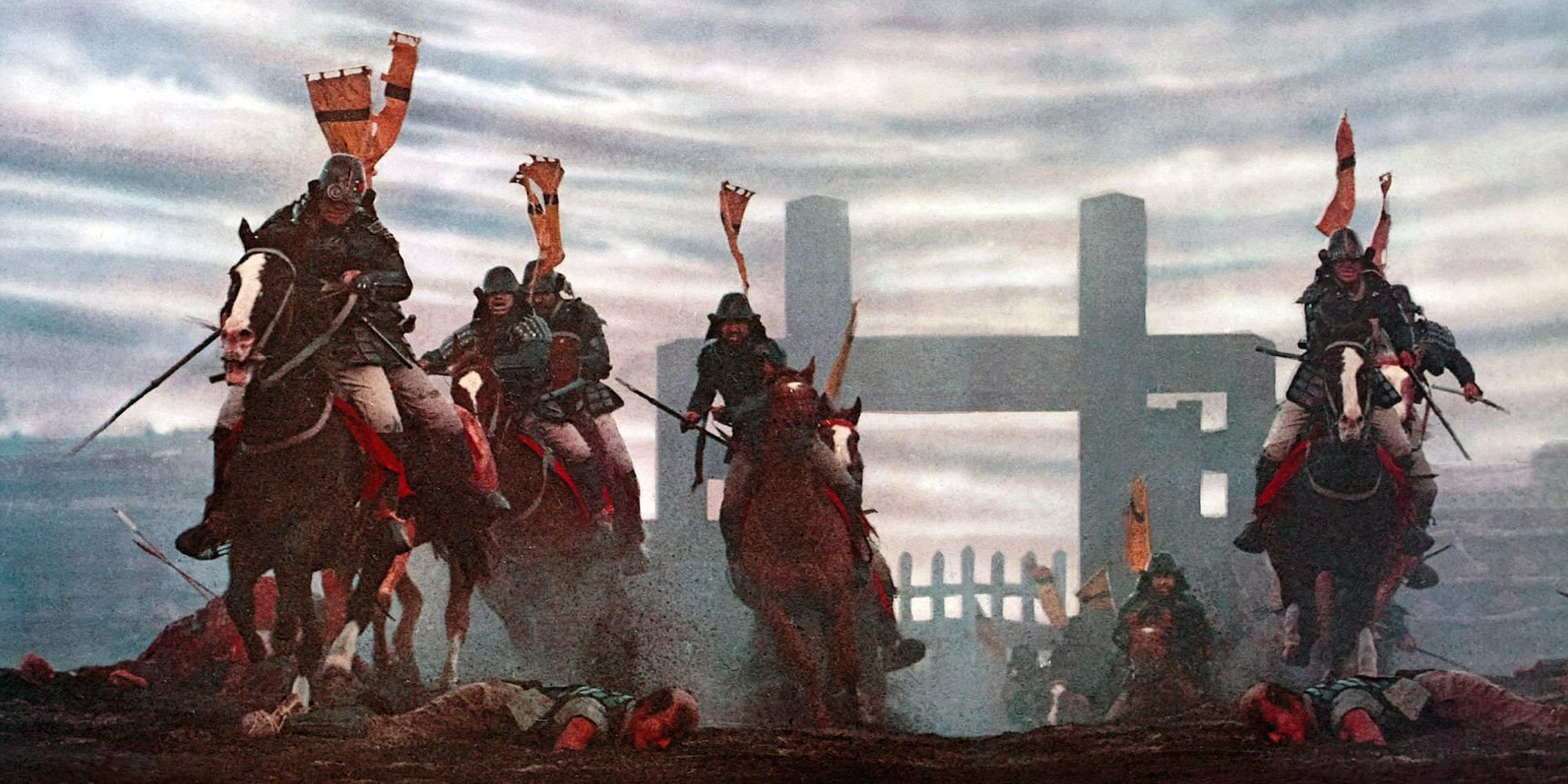
All of those above-mentioned strengths are not only on display in Ran, but fully realized, and even more apparent than in his earlier films. Its runtime might not quite make it his longest film, but due to its expert pacing, it feels like it might well tell the biggest story in his filmography, taking place in multiple locations, featuring various armies going to war, and also keeping things personal with plenty of non-action scenes that involve characters trying to talk through their differences. And for as impressive as Kurosawa’s past action scenes had been, none match the scale of the battles present in Ran. In particular, the sequence showing the invasion of the third castle is masterful, and an example of Kurosawa’s knack for visual storytelling at its best, seeing as it plays out without dialogue. Ran really is the best of both worlds, having fantastically acted sequences with great dialogue, and also making sure to deliver spectacle – some of it harrowing – that doesn’t need dialogue to express or impress.
‘Ran’ Is Kurosawa’s Most Beautiful-Looking Movie

That battle sequence at the third castle – and its nightmarish aftermath – might not be beautiful in a traditional sense, but the way it looks is staggering, and makes it stand out as one of the best scenes in any Kurosawa movie. Elsewhere, Ran is consistently magnificent to look at, with it being one of those films where the somewhat clichéd saying “every shot could be a painting” genuinely feels like it could apply. Not only are the colors bold and varied, but they serve a purpose beyond being used to create some fantastic-looking images. Each of the aging warlord’s sons – who fight over his kingdom – gets represented by a different color: red, yellow, and blue. This is made clear from the film’s opening scene, which kicks off the plot, and also proves useful in the later battle sequences, given each son’s army wears colored uniforms that make them easily identifiable among their opposing soldiers.

Maybe that feels on the nose or a little obvious, but it suits the style of the film, makes the action clearer and more satisfying, and yes, it also looks pleasing to the eye. Primary colors are considered primary colors for a reason. They stand out and look good, and since most of the epic sequences and battle scenes take place during the day, everything is very clear and stunning to look at. The red, yellow, and blue armies clashing under blue skies and on green fields, and the way destruction, debris, and smoke smother some scenes in gray… it all looks great. Dodes’ka-den and Dersu Uzala used color well, but it was ultimately Kagemusha that first showed how excellently Kurosawa could use color, even though it took him until 1970 to stop using black-and-white for his movies. Like Ran, Kagemusha also features bold, often primary colors, dramatic lighting, and some strange yet absorbing colors during a particularly famous nightmare sequence.
‘Ran’ Paved the Way for Kurosawa’s Interesting Final Direcing Decade
Ran may not have been a huge financial success, but it was critically acclaimed upon release. It even got some recognition from the Academy Awards, with Akira Kurosawa finally receiving a nomination for Best Director (his only one) at the age of 75. Time has been very kind to it, and it’s now generally regarded as one of the director’s greatest films, if not his greatest. Yet even if it felt like a grand, potentially final film, it certainly wasn’t his last. In 1990, he directed the incredibly underrated Dreams, which is a surreal anthology film that visualizes a collection of dreams Kurosawa had by putting them on screen. Like Kagemusha and Ran, the use of color in Dreams is phenomenal. 1991 and then 1993 saw the release of Rhapsody in August and Madadayo, respectively. Neither’s among his very best works, but both hold up as compelling films. Each feels like they were made by a director in the later stages of their life, with both being contemplative, deliberately paced, gentle, and often moving films that focus on Japan’s 20th-century history and themes surrounding family and growing old.
His three post-Ran films collectively serve as a fitting epilogue to a fruitful career, though Ran is still the film that feels like his career’s grand climax. It features a larger story than any he’d told before, boasts some career-best visuals and action sequences, and highlights tragedy, drama, and excitement just as well as any of his movies made during the 1950s and 1960s, which is when he was at his most prolific. For as great as Ran is, it’s ultimately most powerful when viewed after familiarizing oneself with at least some of what came before. Newcomers to Kurosawa’s filmography may want to start with his earlier black-and-white films, and then move on to his late-career epics like Kagemusha and Ran, just to appreciate how far he came as a director. Kurosawa never ceased trying to improve as a filmmaker and outdo what he did before, and in the process of his career-long quest to make the greatest films he could, he pushed cinema as an art form forward considerably, and gifted the world with numerous classics that remain beloved and compelling watches to this very day.
[ad_2]
Original Source Link