












































U.S. manufacturers entered August with a guarded sense of relief. After months ofturbulence,improvingdemand andeasingtensionarefinallygivingCEOs reasonsto believe the worst of the year may be behind them.
Chief Executive’s latest CEO Confidence Index, fielded August 4 and 5 among 285 U.S. CEOs, finds manufacturers rate current business conditions a 5.8 out of 10, on a scale where 1 is Poor and 10 is Excellent.With a 4percent improvement over July, current confidence has finally pushed past the 5.5–5.7 range, where ithadbeen hovering since February.
Manufacturers’ outlook for the year ahead also improved, climbing back to 6.1/10 from 5.9 in July—the lowest forecast on record for 2026. The gain partially erases July’s 7 percent decline and brings manufacturing CEOs into alignment with their non-manufacturing peers,whoprovide the same 6.1/10 forecast.
When asked about the factors driving their improved confidence, manufacturers mentioned improved demand as key.
“Demand isincreasing,we are an automation company positioned well for success [and] geopolitics is settling down,” says the CEO of a small-sized industrial manufacturer headquartered in Ohio.
Othersroottheir future confidence in the conviction that domestic volatility is soon to ease: “Political noise will calm down either way after [the] midterm elections. Politicians will need to get back to focus on thereal issues,”saysAndrew Ly, CEO of the large-sized consumer manufacturing firmLy Brothers Corp.
Several executives also pointedto reshoring activity and strong order backlogsas reasons for renewed confidence in their investment and planning horizons. Others notedimproving margins aftera long periodof pressure.
Still, many CEOs continue to note the burden of tariff policy and inconsistent regulation.According to Dan Nibe, CEO of LBS Bookbinding, a mid-sized industrial manufacturer, “tariffs are holding the economy back, inflation is squashing the U.S. consumer—but the job market remains strong.”
ECONOMIC OUTLOOK
Despite the improvements to overall confidence, manufacturing CEOs’ bullish expectations for the U.S. economy cooled in August.Fifty-threepercent now forecast some kind of growth over the next six months, down from 65 percent in July.The decline waslargely drivenby a sharp increase in the proportion of manufacturers forecasting flat conditions, which increased by 59 percent sincelast month,from22 percentto35 percent.
Some CEOs say their hesitancyto predictgrowth isdue toinflationary conditions. “Inflationary factors [are] leading to rapid and sustained price increases, which are squeezing our margins severely and pricing some of our products out of the market,” says Tim Zimmerman, CEO of Mitchell Metal Products, a mid-sized industrial manufacturing firm.
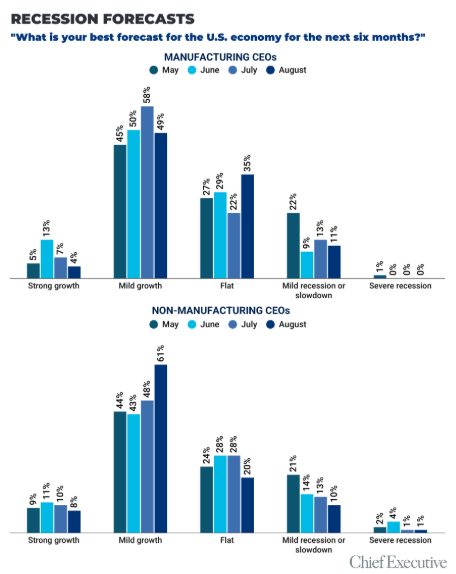
At the same time, recession fears continue to ease. Just 11 percent of manufacturers forecast any kind of recessionary conditions, down from 13 percent in July.
Non-manufacturers moved in the opposite direction on economic growth, with 69 percent forecasting growth over the next six months, up sharply from 58 percent in July and the highest share recorded since May. Their recession fears also eased, with the same proportion forecasting a slowdown.
INTERNATIONAL EXPOSURE
A divergence between internationally exposed manufacturers and those solely focused on domestic operations continues to shape the sector’s outlook. Manufacturers with global operations rate current business conditions a 5.7 out of 10, while their domestic-exclusive counterparts provide a far more optimistic rating of 6.1.
A rationale for the difference, some domestic manufacturers say, is a phenomenon known as trade inversion. Chris Boyd, CEO of Antebellum Manufacturing, a mid-sized consumer firm with U.S.-exclusive operations, explains it best: “Tariffs on primary aluminum have driven the cost for aluminum more for domestic manufacturers than the 50 percent tariff on derivative products… imports are winning.”
Put plainly, some manufacturers are penalized by the tariff on inputs more than they are protected by the tariff on finished goods.
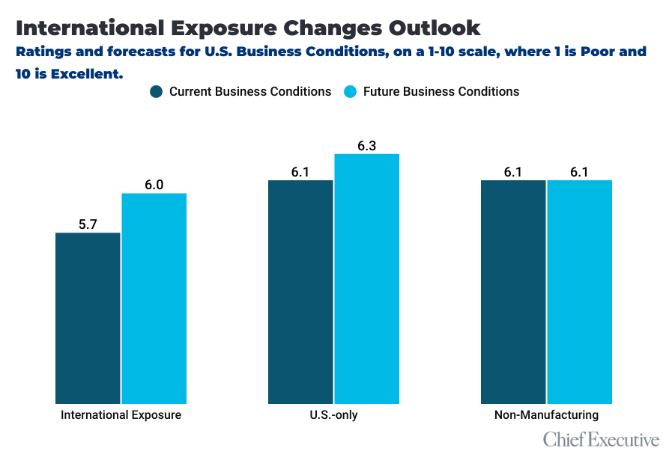
Both groups expect improvement over the next 12 months, but U.S.-exclusive CEOsremainmore optimistic, forecasting business conditions will reach 6.3/10 by this time next year, versus a clean 6.0 for internationally exposed firms.
This domestic-global gap has persisted throughout much of 2026, reflecting the outsized impact that uncertainty surrounding trade policy, geopolitical volatility and supply chain disruption have had on firms with global footprints.
CORPORATE FORECASTS
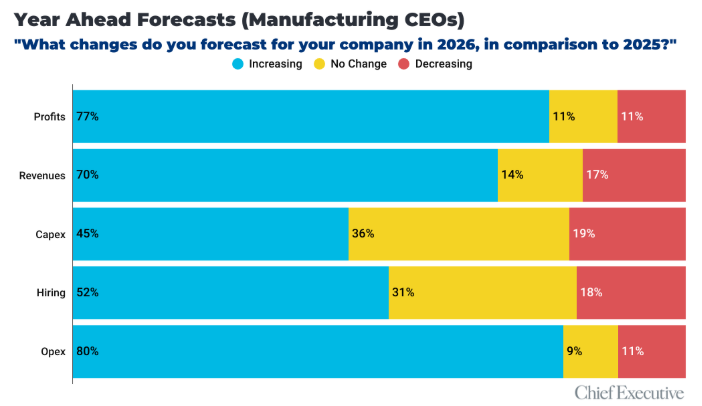
Manufacturers’ company-level forecasts are yet again a mixed bag in August, and continue to fluctuate month-to-month, suggesting CEOs are struggling to form consistent plans in this environment:
- 70 percent of manufacturers expectrevenuesto increase in 2026 (down from 73 percent in July)
- 77 percent forecastprofitsto increase this year (up from 67 percent last month)
- 45 percent plan to add to theircapital expenditures(up from 37 percent in July)
- 52 percent plan to add to theirheadcount(up from 42 percent last month)
- 80 percent foresee increases to theiroperational expenditures(up from 77 percent in July)
About the CEO Confidence Index
Since 2002, Chief Executive Group has been polling hundreds of U.S. CEOs at organizations of all types and sizes, to compile our CEO Confidence Index data. The Index tracks confidence in current and future business environments, based on CEOs’ observations of various economic and business components. For additional information about the Index and prior months data, visit ChiefExecutive.net/category/CEO-Confidence-Index/