
























































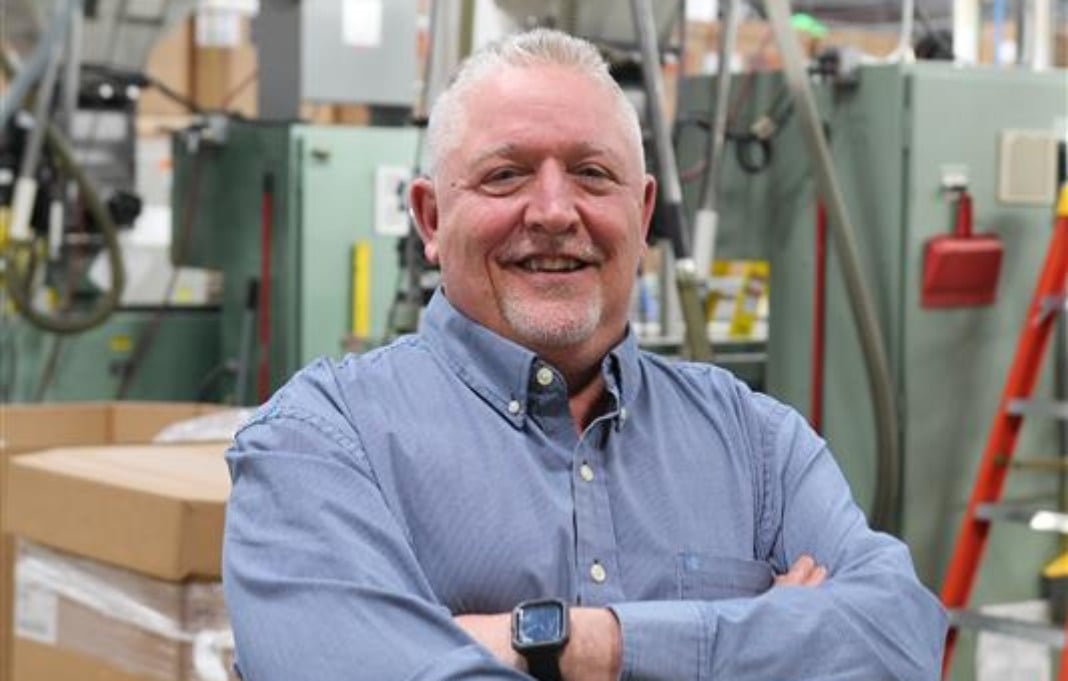

The trade volatility of the past year has many manufacturers thinking twice where they set up shop. While it’s difficult for domestic manufacturers to compete on pricing alone, John Danes, president of Kent Elastomer Products, argues that the total value proposition for companies in the U.S. is an advantage that shouldn’t be ignored.
Kent Elastomer Products, an Ohio-based manufacturer of tubing and dip-molded products, has been manufacturing in the U.S. since its founding in 1960—making everything from tourniquets to sling shots to the inner workings of ketchup dispensers.
In an interview, Danes shares how U.S. manufacturers can remain competitive and what he sees on the horizon for Kent Elastomer Products, and the industry at large.
U.S. manufacturers continue to face intense competition from offshore producers. From your perspective, what does it truly take for American manufacturers to remain competitive in today’s global market?
U.S. manufacturers must be priced competitively and demonstrate their total value proposition to prospective and current customers in several ways. They can add value through geographical convenience and being in the same or similar time zone. Domestic manufacturers can also minimize potential supply chain disruptions, such as ocean shipment interruptions, port strikes, political turmoil and piracy.
Ultimately, we know it is hard to compete with offshore producers on price. We take pride in our great quality and customer service.
Many offshore competitors compete primarily on cost. How can U.S.-based producers differentiate themselves and why are quality, innovation and supply-chain reliability becoming increasingly important factors for customers?
While many offshore competitors focus primarily on piece-price cost, U.S.-based producers can differentiate themselves by delivering greater overall value. Quality, innovation and supply-chain reliability have a direct impact on the total acquisition cost of a component, just its upfront price, as well as the overall end-user experience.
When components perform exactly as designed, particularly in critical healthcare applications, manufacturers reduce risk and ensure consistent, dependable outcomes. Higher quality standards also help minimize the costly disruptions associated with repairs, rework and recalls. Reliable supply chains further protect OEM brand reputation by ensuring consistent product performance and dependable availability.
In addition, a commitment to continuous, incremental improvement enables U.S. producers to control costs and eliminate waste across business processes, delivering long-term value that extends well beyond initial pricing.
Elastomer components often play a behind-the-scenes but critical role in medical, infrastructure and industrial applications. How are advancements in elastomer solutions helping strengthen domestic manufacturing capabilities?
Elastomer components may operate behind the scenes, but they play a vital role in medical, infrastructure and industrial applications, and advancements in elastomer solutions are significantly strengthening domestic manufacturing capabilities. U.S. material suppliers are innovating aggressively to compete with overseas producers, with the pace of innovation accelerating and material “matching” becoming more common to meet specific performance requirements.
A strong emphasis on material purity is also critical. Maintaining formula integrity without relying on low-cost fillers helps ensure long-term product performance and durability while minimizing the risk of chemicals or foreign substances leaching during use.
At the same time, innovation in alternative materials is reducing reliance on more expensive incumbents, delivering comparable performance at a lower overall acquisition cost, such as the growing use of thermoplasticelastomer in applications traditionally served by silicone.
Looking ahead, where do you see U.S. manufacturing headed over the next five to 10 years and what role will specialized elastomer solutions play in supporting critical industries and reshoring efforts?
Over the next five to 10 years, U.S. manufacturing will continue to face competitive pressures, as operating in a global economy means cost challenges are unlikely to disappear. However, manufacturers that embrace a total acquisition cost approach, both in pursuing new business and managing existing customer relationships, will be better positioned to differentiate themselves from less capable foreign competitors.
Lean initiatives and disciplined cost management will remain essential, and companies that fail to innovate their processes or eliminate inefficiencies will struggle to maintain competitive pricing while preserving the margins necessary to grow.
Specialized elastomer solutions will play a critical role, particularly in industries such as biopharmaceutical and medical, where consistently high-quality materials, those that are free from unnecessary filler ingredients often used in low-cost offshore products, are non-negotiable.
At the same time, reshoring efforts are expected to continue, with many companies prioritizing dual-sourcing strategies that include at least one U.S.-based supplier. If the COVID-19 pandemic underscored anything, it is the importance of strengthening supply chain resilience to prevent major disruptions in critical industries.