








































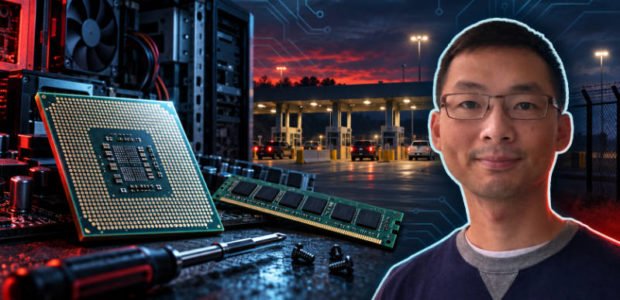
A Chinese national, who worked as a CBP supervisor, was arrested after he was caught on a hidden camera illegally modifying security computers.
Here’s the news via Maine Wire:
A Chinese national who managed to get a job working as a U.S. Customs and Border Protection supervisor in Calais has been arrested and charged in what FBI agents claim was a plot to install modified hardware in Department of Homeland Security computers.
Terry “Jiajia” Liu — originally of Guangzhou, per his Facebook page — was arrested after a counter intelligence investigation captured hidden-camera footage of him breaking into government computers and modifying the hard drives.
According to court records released Friday in Maine District Court, Liu is alleged to have stripped valuable components from government computers, replaced them with inferior parts and traded the originals to an electronics retailer for credit.
Liu, 39, is charged with theft and damage of government property in a case involving 46 altered computers at three Maine border facilities. Prosecutors are seeking to keep him jailed, citing frequent international travel, financial resources and a home close enough to Canada that an ankle monitor might not prevent him from leaving the country.
The alleged scheme persisted after a port director explicitly warned Liu not to move computers or their parts. Investigators later installed cameras that, according to an FBI affidavit, captured the supervisor opening government computers and swapping components during overnight shifts.
The affidavit doesn’t state or imply that the alternative hardware the Chinese national installed on Homeland Security computers might have served an espionage purpose.
The government estimates that restoring the altered parts would cost $20,460. Replacing all 46 computers would cost an estimated $105,800, before additional expenses to configure them for government use.
Liu appeared Thursday before U.S. Magistrate Judge John C. Nivison in Bangor, where he was ordered temporarily held without bail pending a detention hearing scheduled for Friday morning. He waived a preliminary hearing but requested a hearing on the government’s detention motion.
According to FBI Special Agent Christopher J. White’s affidavit, Liu was a CBP supervisor assigned to the Calais Port of Entry, with responsibilities extending to Ferry Point and Milltown. His job included limited information-technology duties, but he was not authorized to modify computers.
It sounds like Liu was stealing parts out of CBP computers and selling them on Newegg. He’d then replace the parts he stole with older computer parts:
On March 18, 2025, Port Director Theodore Cummings put that restriction in writing after speaking with Liu.
“Please do not move any computers or computer parts,” Cummings wrote.
The email distinguished equipment maintained by a contractor from CBP computers, which were to be serviced by the agency’s information-technology personnel.
“I do appreciate the intent but we should stay in our lane and report deficiencies through the work ticket process,” Cummings wrote.
Months later, CBP personnel discovered that approximately 23 computers had been modified without authorization. Original processors, memory and hard drives had been replaced with components that did not meet agency requirements. Many of the machines had been reconnected to the CBP network.
A subsequent inventory expanded the total to 46 computers: 38 at Calais, six at Ferry Point and two at Milltown.
Thirty-nine had undergone processor replacements, six had memory changes and eight had hard-drive changes, according to the affidavit. Some machines had more than one type of modification.
The government computers were equipped with 14th-generation Intel processors. Investigators found that many had been fitted instead with older processors or Intel Pentium models. Other machines had less memory or storage than their original configurations.
Investigators also found a potential route for the missing parts: Newegg’s trade-in program.
The affidavit describes 13 emails Liu sent from a personal account to his official CBP email address containing shipping labels and trade-in summaries for processors matching the model missing from government computers. The offers were for $200 or $210 apiece.
Records obtained from Newegg showed that Liu received credit for trading in 14th-generation Intel Core i7 processors 16 times between May 2025 and July 2026, according to the FBI. Investigators also identified three $200 Newegg credits in his American Express records.
The criminal complaint charges Liu with stealing 10 Intel processors worth more than $1,000 between approximately May 2025 and January 2026. A second count alleges that he damaged or attempted to damage CBP computers between January and March 2026, causing more than $1,000 in damage or attempted damage.