





































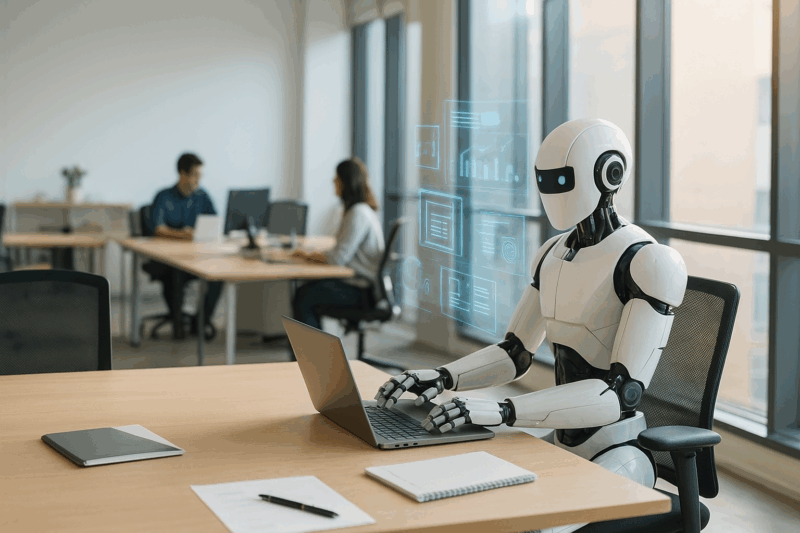

During the last few years, many folks have expressed angst about AI, particularly the job destruction it may cause. To be sure, some of the angst is hype, but some of it is justified. However, technology has a long history of changing jobs without eliminating the need for human expertise. The WYSIWYG editor — short for “what you see is what you get” — offers one example of how technology can change work without making workers obsolete.
MTV launched in 1981 with the Buggles music video for “Video Killed the Radio Star,” a great nod to the channel’s focus on music videos. Nearly 45 years later, radio is still going strong. Audio has boomed with podcasting and audiobooks.
Likewise, the WYSIWYG editor, dating back to at least 1974, as a martech example, didn’t eliminate the need for coders. Even as WYSIWYGs grew in adoption with content management systems (CMS), website content managers still needed folks who know how to use HTML, CSS, PHP, and JavaScript, among other coding languages.
How AI is shifting roles
While vibe coding enables non-coders to use natural language prompts to generate their own code, programmers are still needed. However, their role is shifting more to editor than writer. That’s understandably unsettling because software engineering has long been seen as a career offering job security, high pay, and upward mobility.
Varsha Banal, writing in The Guardian, said that this may seem like a simple shift, but it’s not always easy.
“Software engineers are frustrated, anxious, and trying to adapt to a startling new reality in which the value of their skills is unclear. As a result, they’re doubling down on fundamentals, chasing new skills to stay relevant, seeking collective action to push for better protections, or even contemplating exiting the industry entirely.”
Some professionals will not transition. This is partly due to overall skill sets and interests.
10X your SEO with Semrush for Enterprise.
The world’s most powerful SEO platform, purpose-built for Enterprise.
Request demo
Responding to an AI-disrupted workforce
Fortunately, people are working on solutions to the structural changes in job markets.
For instance, Raise U.S. is a nonpartisan group led by Secretary Gina Raimondo, the U.S. Secretary of Commerce during the Biden administration and former governor of Rhode Island, and Gov. Eric Holcomb, former Republican governor of Indiana.
It’s looking for ways, in the AI era, to avoid the economic and social costs society incurred during the late 20th-century transfer of manufacturing from the country to other parts of the world.
There’s also What Will We, a grassroots organization founded by software engineer Kaitlin Cort. As Cort saw her work change, she decided to find ways to support other knowledge workers who are also experiencing this rapid change in their work.
It supports workers displaced by AI through a community job board, layoff crisis support, shared learning tools, job application tracker, civic tech projects, and a resource library. As of mid-July 2026, forthcoming resources include a basic income pilot and mutual aid fund.
Companies can put human expertise to work
Another productive solution is to champion companies that successfully elevate the value human employees deliver after AI takes over some of their duties. A few large companies avoided staff reductions by redeploying employee effort.
Stephanie Davis, a columnist for Inc., explained how IKEA retrained its customer support agents to provide interior-decorating guidance.
“[IKEA] analyzed what people were asking for that bots couldn’t provide and discovered a massive untapped market. Customers wanted more interior design assistance, so [the company] retrained the 8,500 employees to offer premium design services. The new channel accounted for $1.7 billion in 2024 (3.3% of total revenue) and is projected to grow to 10% by 2028.”
That helps draw customers into stores to consult with employees who can help drive purchases.
In his book “Reshuffle,” Sangeet Paul Choudary explained how Best Buy competes with its brick-and-mortar and digital competitors by training its in-store associates to assist customers with complex electronic purchases. Likewise, this draws customers to stores.
Both companies found ways for their employees to offer more value, as many of their repetitive tasks were taken over by websites and AI. Such examples show how organizations and individuals can jointly reap the benefits of the AI revolution.
Gartner found that many companies that had AI-driven layoffs regret it. While AI has vast knowledge, it lacks human judgment.
Human expertise still matters
For now, LLMs can hallucinate. They sometimes produce output that deserves human review. Many of the platforms acknowledge this by giving explicit warnings to users to double-check output.
This means that humans are essential when anyone — including companies — uses AI. While this may shift where humans add value, they’ll remain essential.
Even as AI takes over more tasks, it’s still critical for some folks to understand the fundamentals of various disciplines. Many enterprise organizations move at a glacial pace in regard to technology. For example, some federal government systems in the United States still use COBOL from the 1950s, and that requires folks to understand the programming language.
Beyond that, older knowledge can still spark technological advancement.
Martech careers are changing
Marketing technology careers aren’t immune to the encroachment of AI. AI will automate some jobs, adjust other jobs, and create brand-new jobs. Beyond traditional professional development, there are other ways practitioners can adapt to a new job market.
Develop new skills
If you’re a mid-career professional like me, you might lack the habit of thinking about using AI. It’s important to find a few small tasks to regularly harness AI using employer-approved tools. Then focus on using them. That will help shift a mindset established prior to the paradigm shift. Hopefully, new skills will accompany new habits.
It’s also important to promote your own successes. That can show your superiors the value you provide to the organization. They’ll take note and keep you in mind for future opportunities. A recent vice president whom I reported to reminded me that self-promotion isn’t always selfish.
Solve problems
It’s also important to experiment by using platforms to solve problems.
For instance, as a marketing director overseeing the Utah ski resort Snowbasin, Michael Rueckert noticed that AI chatbots weren’t recommending Snowbasin when asked about great places to ski. He used Claude to develop a solution to boost such recommendations.
Rueckert used that experience to start a company, Centium, to help other companies with AI visibility through answer engine optimization (AEO) and generative engine optimization (GEO) services.
Rueckert is one example of how a professional can chart a new career path.
Finding a path through AI-driven change
A consistent response to change is resistance. This is even true for positive and neutral changes — perceived or otherwise. Change isn’t always easy. All sorts of professionals — including martech practitioners — must confront AI-driven change.
The good news is that there’s hope. There are people who are actively thinking and acting to meet our shifting workforce needs.
Besides, in order for companies to thrive, they need customers who can afford their offerings. If businesses replace workers with AI, who will be able to purchase their wares? After all, they’ll need to pay people so they can afford to buy those products.
Remember that video didn’t kill the radio star after all.