

















































Note: This review was originally published as part of our 2026 Sundance coverage. The film arrives in theaters on November 6.
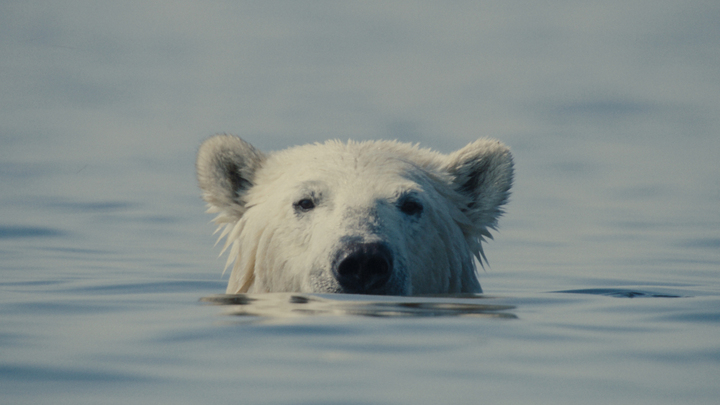
Gabriela Osio Vanden and Jack Weisman’s Nuisance Bear is an expansion of their 2021 short film of the same name, which followed a polar bear on its annual migration through Churchill, Manitoba, the “Polar Bear Capital of the World.” Through visual storytellingalone, they captured not only the behavior of the animal but also the increasingly politicizedenvironment that bears have had to adapt to in modern times. One aspect of thisenvironment is the Churchill wildlife management program, which rounds up Avinnaarjuk, or “nuisance bears,” and keeps them in a holding facility until they are ready to be transported north. Another aspect is the town’s booming tourism industry, which offers people the chanceto see polar bears in the wild, and which was beautifully encapsulated in a slow-motiontracking shot of a bear nonchalantly crossing a road while a dozen or so tourists scrambled toget the perfect picture. This tension between profit and protection, between exploitation andconservation, is explored in much more depth in Vanden and Weisman’s latest feature, thanks to yet morestunning compositions and some crucial historical context provided by Inuit narratorMike Tunalaaq Gibbons.
The polar bear’s journey is split into two parts. The first part begins with the bear’s entry intoChurchill and ends with its being airlifted out of town by helicopter. Scenes of wildlifeofficers on patrol and tourists on bear-spotting expeditions are interspersed with thebear’s ceaseless hunt for food, which in one particularly intense scene means trying to grabsome meat from one end of a trap without triggering the ominous metal gate at the other. Inthe second part, we move with the bear to Arviat, Nunavut, which is the next town north ofChurchill and home to a largely Inuit community. Gibbons recounts how white colonizerstried to stamp out the Inuit language and way of life, resulting in the breakdown of familynetworks and generational ties. We also see snippets of town hall discussions about bearactivity and management, the operational challenges of safeguarding a town from themduring Halloween, and preparations for the annual bear harvest.
Although there are many dramatic moments—the scenes of trucks and helicopters shooingbears out of town often look like high-speed chases—the main tone is one of socioecological reflection. As Gibbons makes clear, the pernicious contradictions that characterize thecurrent situation in Churchill—for instance, that the profitability of the tourism trade is to alarge extent dependent on the vulnerability of the bears—is inextricably linked to thecolonization and exploitation of the Inuit communities, and, more generally, to the attitudesand values that continue to make that oppression possible. Only in a system built on profitand power could well-meaning conservation work require that polar bears continually be sentfurther north, where they inevitably trouble rural communities who had no problems withthem before, or that conservation workers set terrifying traps, use deafening firecrackers asdeterrents, and tranquilize stranded bears for nibbling garbage.
As Murray Bookchin points out in this brilliant lecture, our attitudes towards the naturalworld are extensions of the social relations that exist between human beings. If those socialrelations are built on ideas of domination and exploitation, so will our attitudes towardsthe natural world. It is hard to watch Nuisance Bear and not see, for example, that theadversarial nature of the conservation program in Churchill—from the process of forcefullyrounding up the bears to the use of so-called “polar bear jails”—is an obvious translation, bothin spirit and practice, of many countries’ policies towards immigrants. Likewise, the angerand frustration that many Inuit communities now feel towards the bears, after having lived inrelative peace with them for generations, is an expression of capitalism’s drive to eradicateIndigenous knowledge and more egalitarian ways of life. Gibbons puts it most succinctlytowards the end of the film: “Everything is interconnected. There is no separation betweenourselves and nature. This story of a bear is a story about us.”
Nuisance Bear premiered at the 2026 Sundance Film Festival.