














































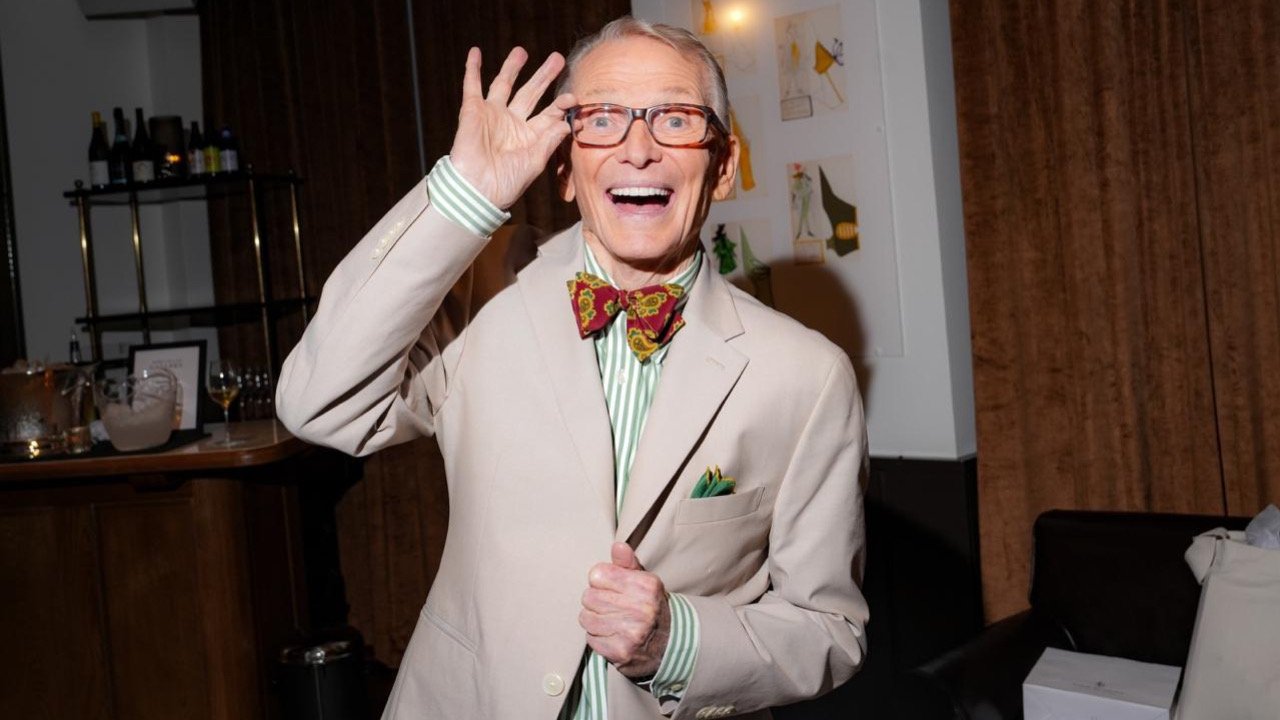
Bob Mackie, the legendary fashion and costume designer known for his spectacular creations for Cher, Carol Burnett, Diana Ross, and other entertainment icons, has died at 87. The news of his death was announced today, Monday through his official Instagram account. The cause of death has not been disclosed.
“It is with a heavy heart that we share the news that Mr. Bob Mackie passed away today,” the statement read. “He lived his 87 years to the fullest, fulfilling his dream of being a Fashion and Costume Designer, which is all he ever wanted to do. His genius and extraordinary designs will live on forever, continuing to bring beauty into this world.”
The announcement brings an end to a career spanning more than five decades, during which Mackie established himself as one of the most influential costume designers in television, film, theater, and popular culture. Known as the “Sultan of Sequins,” he became synonymous with flamboyant gowns, elaborate headpieces, figure-hugging silhouettes, and stage costumes designed to command attention.
Bob Mackie’s Career Began In Hollywood’s Golden Age
Born Robert Gordon Mackie on March 24, 1940, in Monterey Park, California, Mackie developed his skills working alongside some of Hollywood’s most respected costume designers. After attending Pasadena City College and the Chouinard Art Institute, he began his professional career as a sketch artist for Jean Louis and later worked as an assistant to Edith Head.
He subsequently worked with costume designer Ray Aghayan, who became his longtime professional collaborator and life partner. Together, Mackie and Aghayan worked on numerous productions, including “The Judy Garland Show.” Their work on the 1966 television special “Alice Through the Looking Glass” earned them the first-ever Emmy for costume design.
Mackie’s career expanded rapidly after Mitzi Gaynor recruited him to create costumes for her Las Vegas revue and television specials in 1966. His work caught Carol Burnett’s attention, leading to an 11-season run designing costumes for “The Carol Burnett Show.”
His Designs Became Part Of Television History
Mackie’s work for Burnett demonstrated the unusual range that separated him from many of his contemporaries. He could create glamorous evening gowns and elaborate production costumes, but he was equally comfortable designing clothes intended to generate laughs.
His most famous creation for the series was Burnett’s “curtain-rod” Scarlett O’Hara dress from the “Went With the Wind!” sketch, which spoofed the iconic green curtain gown from “Gone With the Wind.” Burnett later credited Mackie with creating costumes that helped her understand the characters she was portraying and enhanced the comedy of the sketches.
Mackie estimated that his work for the show eventually encompassed thousands of individual pieces. His ability to combine humor, theatricality, and craftsmanship became a defining characteristic of his career.
Cher And Bob Mackie Created An Iconic Fashion Partnership
Mackie’s most famous celebrity collaboration was undoubtedly Cher. He designed many of the singer’s most memorable television, concert, and red-carpet looks, including the revealing black ensemble she wore to the 1986 Academy Awards.
The outfit featured black stretch pants, a jeweled loincloth, a chain-link top, knee-high boots, and an enormous feathered Mohawk headpiece. It immediately became one of the most talked-about Oscar looks of its era.
Mackie and Cher continued working together for decades. He also created costumes for “The Sonny & Cher Comedy Hour,” “Cher,” “The Sonny and Cher Show,” and Cher’s concert tours. His work with her earned him two Emmy Awards, while his contribution to “The Cher Show” eventually earned him a Tony Award in 2019.
An Award-Winning Career Across Film And Theater
Bob Mackie died with an extensive list of professional honors behind him. He received three Academy Award nominations, including recognition for “Lady Sings the Blues,” “Funny Lady,” and “Pennies From Heaven.” His work on “Funny Lady” involved creating dozens of complete 1930s-inspired looks for Barbra Streisand’s Fanny Brice, including accessories such as hats, gloves, scarves, and shoes.
His television career produced more than 30 Emmy nominations and nine wins. In 2002, he became the first costume designer inducted into the Television Academy Hall of Fame.
Beyond television and film, Mackie designed costumes for Broadway and other theatrical productions, including “Lorelei,” “On the Town, Platinum,” “Moon Over Buffalo,” and “Putting It Together.” He also created costumes for major Las Vegas productions, including the elaborate Hallelujah Hollywood, which featured 940 costumes.
His Influence Extended Beyond The Stage
Although Mackie became famous for dressing entertainers, his influence extended into consumer fashion and popular culture. He launched ready-to-wear collections and collaborated with QVC on fashion and home furnishings. He also created elaborate Barbie dolls beginning in the 1980s, many of which became sought-after collectibles.
His designs continued appearing in contemporary entertainment decades after their original debut. Most recently, Mackie’s work became part of the final season of “Hacks,” where costume designer Kathleen Felix-Hager recreated a famous Carol Burnett look with his assistance.
Mackie’s personal life was marked by significant loss. His longtime partner, Ray Aghayan, died in 2011, while his son, Robin Mackie, died from an AIDS-related illness in 1994.
A Lasting Legacy In Fashion And Entertainment
The death of Bob Mackie leaves behind the legacy of a designer whose work helped redefine what celebrity costume could be. His clothes were deliberately theatrical, but they were also closely tailored to the performers who wore them. Whether designing for Cher’s provocative stage persona, Burnett’s comedy, or the glamorous performances of Diana Ross and other stars, Mackie understood that the right costume could become part of the performance itself.
Bob Mackie died after a career that turned sequins, feathers, beads, exaggerated silhouettes, and fearless glamour into a signature language. His designs remain instantly recognizable, and his influence can still be seen whenever entertainment and fashion collide on a major stage.
Featured image:
—Read Also