
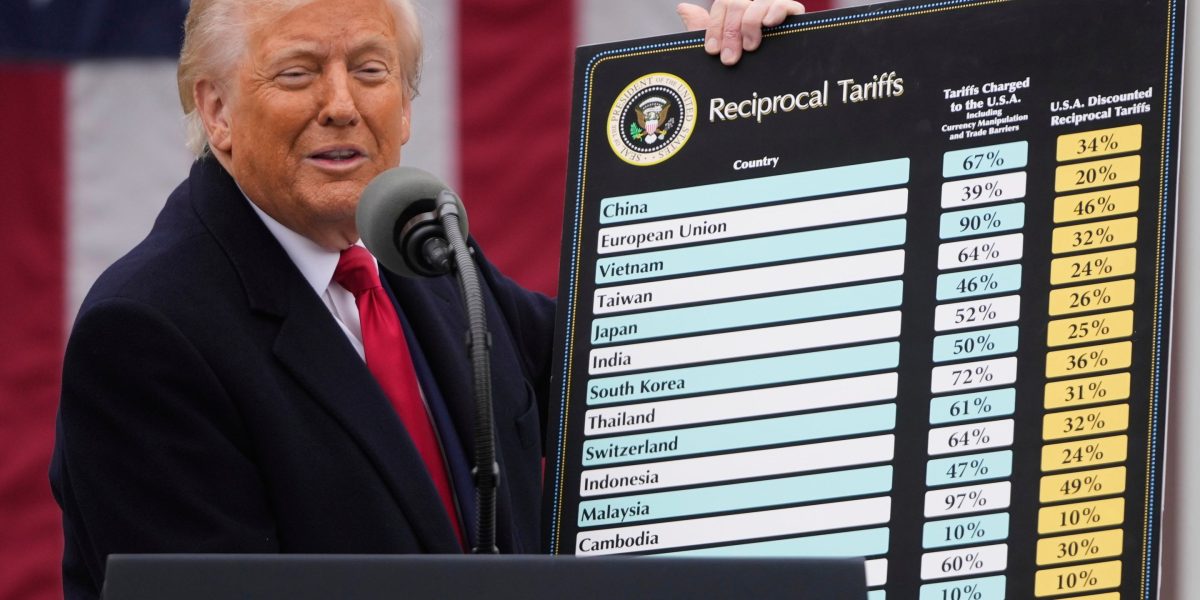










































Following last month’s 24 percent improvement in current business sentiment among manufacturers, another month of cautious positivity has arrived. Trade negotiations driven by the Trump administration in recent weeks—especially with China on the issues of fentanyl precursors and rare earth metals—along with increased business development seem to have worked to maintain a positive manufacturing business forecast into the new year.
According to Chief Executive’s latest CEO Confidence Index Survey, fielded over the first week of November, manufacturing CEOs rate current business conditions a 5.5 out of 10, on a scale where 1 is Poor and 10 is Excellent. Though marginally down 2 percent from last month’s rating of 5.6, manufacturers are still incredibly close to recuperating the March 2025 nosedive in current confidence.
When it comes to future forecasts, manufacturing CEOs are much more optimistic: They project improving conditions, expecting a rise to 6.3 out of 10 by this time next year. On par with July, this is the highest rating of future conditions provided since the winter plummet—and also the first time manufacturers have predicted better conditions than non-manufacturers since June.
Many CEOs attribute this optimism to market growth and the hope that recent trade negotiations will yield positive results. Matt Shieman, President and CEO of composite parts manufacturer Aerospace Composites Solutions, reports that there is “increased demand for” his company’s “products both domestically and international[ly]. Recent certification approvals [have] opened up new markets as well.”
Other manufacturers agreed. Terrence P. Meier, CEO of machinery manufacturer Allways Precision, attributed his positive forecast to customer investment driven by “more certainty with international trade” and a “better understanding of tariff costs and inflation.”

Recession forecasts are especially positive this month: 44 percent of manufacturing CEOs now expect to see mild economic growth over the next six months, up from 36 percent in October. While they remain less optimistic than their non-manufacturing counterparts overall, this is a significant improvement in sentiment.
Much like last month, however, there remains a significant proportion of manufacturers who still forecast some kind of economic decline (26 percent).
Peter Ensch, CEO of capital equipment manufacturer Sani-Matic, can explain the rationale behind this hesitant group: “Our core business of capital equipment for food and beverage is down, and we are in a state of stagflation that will probably continue until food producer and consumer price inflation eases.” Put simply, more time is needed to address sector-specific dynamics such as stagflation and international demand.


REGIONAL RATINGS
Our past Manufacturing Indexes have shown that global manufacturers regularly report poorer forecasts than their domestic-exclusive peers because of tariff pressures and geopolitical tensions. The same can be said this month: 27 percent of manufacturers with international exposure predict some kind of economic decline over the next six months, in comparison to just 21 percent of domestic organizations.
Much of this may have to do with the fact that although recent trade negotiations have eased international headwinds, they are negotiations and not deals. A recent report released by Harvard Kennedy School suggests that the specificity of these talks—focusing on just a few types of resources or goods—has failed to address the needs of many manufacturing sectors, meaning more substantial work may need to be done.
The CEO of a mid-sized firm with operations in Asia, Canada and Australia echoes this need for further clarification: “Tariffs are currently impacting our business segment negatively. I believe with increased certainty, lower interest rates, … and the deregulation policy of this administration, things will pick up next year.”

A further analysis shows that among those manufacturers with global operations, the regions in which they operate can be fundamental to their current rating of business conditions.
CEOs with operations in Africa and Central America, by far, report the best current ratings at 5.78 and 5.63 out of 10, respectively. This likely reflects the high incidence of nearshoring and economic development in those regions.
The region with the poorest confidence rating is Australia, landing at 5.36.

THE YEAR AHEAD
November marks yet another month of surging optimism when it comes to forecasts for the year ahead, with substantial increases across all key indicators:
- 59 percent of manufacturers expect to increase their profits in the year ahead, up 11 percent since last month.
- 67 percent expect to increase their revenues, up 8 percent since last month.
- 46 percent of respondents expect to deploy more capital next year, up 14 percent since October.
- 46 percent expect to add to their headcount over the next year, up 29 percent since last month; this follows on the back of a 38 percent increase between September and October, suggesting strong positive momentum when it comes to hiring.


About the CEO Confidence Index
Since 2002, Chief Executive Group has been polling hundreds of U.S. CEOs at organizations of all types and sizes, to compile our CEO Confidence Index data. The Index tracks confidence in current and future business environments, based on CEOs’ observations of various economic and business components. For additional information about the Index and prior months data, visit ChiefExecutive.net/category/CEO-Confidence-Index/