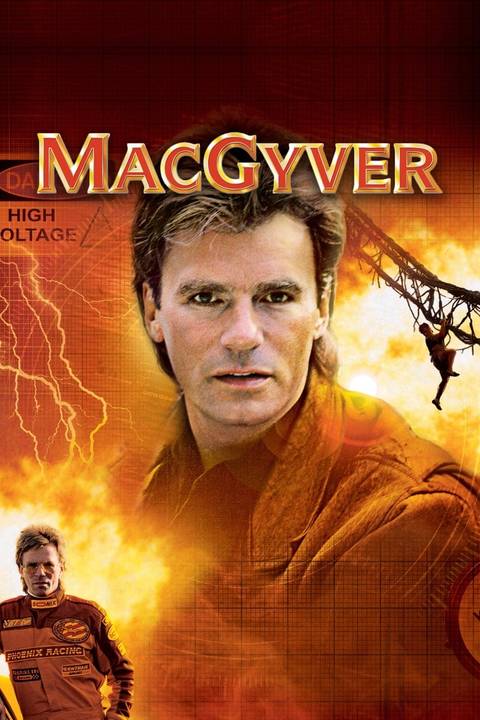
Everybody remembers the legacy of MacGyver. Swiss Army knives, duct tape, household objects being transformed into things household objects were never meant to become…the show practically invented that method. What gets forgotten is that Angus MacGyver wasn’t solving problems because he enjoyed building gadgets. He was solving them because he’d rather spend ten minutes figuring something out than ten milliseconds pulling a trigger.
MacGyver Was the Anti-Action Hero of the 1980s
The setup was delightfully straightforward: MacGyver (Richard Dean Anderson) worked for the Phoenix Foundation — a government think tank housing an intelligence agency — and had a remarkable talent for showing up exactly where things were going wrong. One week, it was terrorists. The next week, it was spies. After that, it was kidnappers, criminals, or somebody whose terrible decision-making had spiraled completely out of control. Most television heroes would’ve solved those problems with bullets, but MacGyver usually solved them by staring at a pile of random objects until an idea appeared.
Collider Exclusive · Action Hero Quiz Which Action Hero Would Be Your Perfect Partner? Rambo · James Bond · Indiana Jones · John McClane · Ethan Hunt
Five legends. Five completely different ways of getting out alive — with style, with muscle, with charm, with luck, or with a plan so intricate it probably shouldn’t work. Ten questions will reveal which action hero was built to have your back.
🎖️Rambo
🍸James Bond
🏺Indiana Jones
🔧John McClane
🎭Ethan Hunt
01
You’re dropped into a dangerous situation with no warning. What do you need most from a partner? The first few seconds tell you everything about who belongs beside you.
02
You have to get somewhere dangerous, fast. How do you travel? How you get there is half the mission.
03
You’re pinned down and outnumbered. What does your ideal partner do? This is when you find out what someone is really made of.
04
The mission is paused. You have one evening to decompress. What does your partner suggest? Who someone is when the pressure drops is who they actually are.
05
How do you prefer your partner to communicate mid-mission? Good communication is the difference between partners and a liability.
06
Your enemy is powerful, well-resourced, and has the upper hand. How should your partner approach them? The approach to the enemy defines the partnership.
07
Things go badly wrong and you’re captured. What do you trust your partner to do? Who someone is when you need them most is the only thing that matters.
08
What does your ideal partner bring to the table that you couldn’t replace? A great partner fills the gap you didn’t know you had.
09
Every partnership has a cost. Which of these can you live with? No one comes without baggage. The question is whether you can carry it together.
10
It’s the final moment. Everything is on the line. What do you need from your partner right now? The last question is the most honest one.
Your Partner Has Been Assigned Your Perfect Partner Is…
Your answers have pointed to one action hero above all others. This is the person built to have your back — for better or considerably, spectacularly worse.
Rambo
Your partner doesn’t talk much, doesn’t need to, and will have assessed every threat in your immediate environment before you’ve finished your first sentence. John Rambo is not a man of plans or politics — he is a force of nature shaped by survival, loyalty, and a capacity for endurance that goes beyond anything training can produce. He will not leave you behind. He has never left anyone behind who deserved to come home. What you get with Rambo is the most capable, most quietly ferocious partner imaginable — one who has been through things that would have broken anyone else, and who chose to keep going anyway. You’ll never need to ask if he has your back. You’ll just know.
James Bond
Your partner will arrive perfectly dressed, perfectly briefed, and with a cover story so convincing it’ll take you a moment to remember what’s actually true. James Bond is the most professionally dangerous person in any room he enters — and the most disarmingly charming, which is the point. He operates in a world of layers, where nothing is what it appears and every advantage is used without apology. You’ll never be bored. You’ll occasionally be furious. But when it matters — when the mission is genuinely on the line and the margin for error has collapsed to nothing — Bond is exactly the partner you want. He has survived things that have no business being survivable. He does it with style. That is not nothing.
Indiana Jones
Your partner will know the history, the language, the cultural context, and exactly why the thing everyone else is ignoring is actually the most important thing in the room. Indiana Jones is brilliant, reckless, and occasionally impossible — but he is also one of the most resourceful, most genuinely knowledgeable partners you could find yourself beside. He approaches every situation with a scholar’s eye and a brawler’s instinct, which is an unusual combination and a remarkably effective one. He hates snakes and gets personally attached to objects of historical significance, both of which will slow you down at least once. It doesn’t matter. What Indy brings is irreplaceable — and the adventures you’ll have together will be the kind people write books about. Assuming you survive them.
John McClane
Your partner was not supposed to be here. He does not have the right equipment, the right information, or anything approaching the right odds. He has a sarcastic remark and an absolute refusal to accept that the situation is as bad as it looks. John McClane is the greatest accidental hero in the history of action cinema — a man whose superpower is stubbornness, whose contingency plan is improvisation, and whose capacity to absorb punishment and keep moving would be alarming if it weren’t so useful. He will complain the entire time. He will make it significantly more chaotic than it needed to be. And he will absolutely, unconditionally, without question come through when it counts. Yippee-ki-yay.
Ethan Hunt
Your partner has already run seventeen scenarios by the time you’ve finished reading the briefing, and the plan he’s settled on involves at least two things that should be physically impossible. Ethan Hunt operates at the absolute edge of human capability — technically, physically, and intellectually — and he brings the same relentless precision to protecting his partners that he brings to dismantling organisations that shouldn’t exist. He is not easy to know and he will never fully tell you everything. But he will carry the weight of the mission so completely, so absolutely, that your job is simply to trust him — and the remarkable thing is that trusting him always turns out to be the right call. The mission will be impossible. He will complete it anyway.
The concept probably shouldn’t work as well as it does. A man solving international crises with household objects sounds like the setup for a joke. The reason it works is Anderson. He never plays MacGyver like a genius, showing off. He plays him like a practical guy who’s slightly baffled that nobody else has noticed the obvious solution yet.
The contrast was especially noticeable in the 1980s. Television action heroes were getting louder, tougher, and increasingly more explosive. Every year, they seemed determined to add bigger weapons and larger body counts. Then there was MacGyver, wandering into danger looking like somebody’s approachable science teacher and somehow leaving with fewer casualties than everybody else.
That’s the part that feels surprisingly rebellious now. Modern action heroes often spend half their screen time processing trauma and the other half launching opponents through walls. MacGyver approached most crises the way ordinary people approach assembling furniture. It might be frustrating. It might take longer than expected. But surely there was a solution that didn’t involve setting everything on fire.
MacGyver’s Intelligence Still Feels Refreshing Today
The gadgets were never really the point. They were a visual representation of how MacGyver viewed the world. Every problem had a solution. Every situation deserved a closer look. Every locked door, broken machine, hostage crisis, or dangerous confrontation could potentially be solved with observation, patience, and a little creativity. That philosophy gives the series an unusual warmth. Even when episodes become ridiculous, and some absolutely do, the show remains rooted in the belief that intelligence is useful. Not intelligence as arrogance. Intelligence as curiosity.
MacGyver succeeds because he notices things, asks questions, and understands how systems work. Then he uses that knowledge to help people. Watching the series now, it’s striking how little that approach has aged. Some of the hairstyles absolutely belong in a museum. Some of the technology looks like it should be displayed beside a fax machine and a stack of floppy disks. Yet the central idea remains surprisingly durable. The world does not need another hero looking for an excuse to pull a trigger, and that’s what makes him one of the best action heroes.
That’s why MacGyver still works forty years later. Not because of the Swiss Army knife or homemade inventions. Not only because Richard Dean Anderson remains endlessly likable, the show endures because it built an action hero around intelligence instead of violence. In an era when so many protagonists solve every problem by hitting it harder, watching somebody use his brain as Plan A still feels like a novelty. And somehow, decades later, that’s what makes MacGyver feel ahead of its time.
Release Date
1985 – 1992-00-00
Directors
Charles Correll, Bill Gereghty, Michael Vejar, Michael Caffey, Cliff Bole, Michael Preece, James L. Conway, Lee H. Katzin, Alexander Singer, Chuck Bowman, Paul Krasny, Dana Elcar, William Gereghty, Donald Petrie, Paul Stanley, Don Chaffey, Ernest Pintoff, Les Landau, Stephen Herek, Stan Jolley, Rob Bowman, Richard A. Colla, Alan Crosland, Jr., John Patterson
Writers
Stephen Kandel, Chris Haddock, John Whelpley, Calvin Clements Jr., John J. Sakmar, Kerry Lenhart, Bill Froehlich, Terry Nation, Rob Hedden, Mark Lisson, David Rich, Joe Viola, Doug Heyes, Jr., Paul A. Magistretti, Thackary Pallor, Jerry Ludwig, Tony DiMarco, Dennis Foley, Brad Radnitz, Nancy Eddo, Robert Sherman, Robin Bernheim Burger, Don Mankiewicz, Douglas Brooks West
We use cookies on our website to give you the most relevant experience by remembering your preferences and repeat visits. By clicking “Accept All”, you consent to the use of ALL the cookies. However, you may visit "Cookie Settings" to provide a controlled consent.
This website uses cookies to improve your experience while you navigate through the website. Out of these, the cookies that are categorized as necessary are stored on your browser as they are essential for the working of basic functionalities of the website. We also use third-party cookies that help us analyze and understand how you use this website. These cookies will be stored in your browser only with your consent. You also have the option to opt-out of these cookies. But opting out of some of these cookies may affect your browsing experience.
Necessary cookies are absolutely essential for the website to function properly. These cookies ensure basic functionalities and security features of the website, anonymously.
Cookie
Duration
Description
cookielawinfo-checkbox-analytics
11 months
This cookie is set by GDPR Cookie Consent plugin. The cookie is used to store the user consent for the cookies in the category "Analytics".
cookielawinfo-checkbox-functional
11 months
The cookie is set by GDPR cookie consent to record the user consent for the cookies in the category "Functional".
cookielawinfo-checkbox-necessary
11 months
This cookie is set by GDPR Cookie Consent plugin. The cookies is used to store the user consent for the cookies in the category "Necessary".
cookielawinfo-checkbox-others
11 months
This cookie is set by GDPR Cookie Consent plugin. The cookie is used to store the user consent for the cookies in the category "Other.
cookielawinfo-checkbox-performance
11 months
This cookie is set by GDPR Cookie Consent plugin. The cookie is used to store the user consent for the cookies in the category "Performance".
viewed_cookie_policy
11 months
The cookie is set by the GDPR Cookie Consent plugin and is used to store whether or not user has consented to the use of cookies. It does not store any personal data.
Functional cookies help to perform certain functionalities like sharing the content of the website on social media platforms, collect feedbacks, and other third-party features.
Performance cookies are used to understand and analyze the key performance indexes of the website which helps in delivering a better user experience for the visitors.
Analytical cookies are used to understand how visitors interact with the website. These cookies help provide information on metrics the number of visitors, bounce rate, traffic source, etc.
Advertisement cookies are used to provide visitors with relevant ads and marketing campaigns. These cookies track visitors across websites and collect information to provide customized ads.